
Rodent infestations can escalate quickly if not handled correctly. Mice and rats are not only a nuisance but also pose serious health and safety risks, such as spreading diseases like hantavirus and causing electrical fires. Here’s the key takeaway: Most trapping failures happen due to incorrect trap size, poor placement, or neglecting entry points. To effectively manage rodents, you need to understand their behavior, choose the right traps, and focus on prevention.
Key Points:
- Trap Size Matters: Use mouse traps for mice and rat traps for rats. Mismatched traps are ineffective.
- Placement is Critical: Position traps along walls and in high-activity areas like behind appliances or near droppings. If you aren’t sure where to start, first identify if you have a rodent problem by looking for signs of activity.
- Seal Entry Points: Mice can squeeze through gaps as small as 1/4 inch; use steel wool or metal to block access.
- Bait Smartly: Peanut butter works best, but use only a pea-sized amount to ensure the trap triggers.
- Monitor and Clean: Check traps daily, clean up droppings safely, and disinfect thoroughly to avoid health risks.
If DIY methods fail, persistent infestations may require professional rodent control services to address hidden nests and prevent re-entry. Prevention and strategic trapping are your best defenses.
7 Common Mouse Trap Mistakes You’re Making
sbb-itb-be66415
Using the Wrong Trap Size
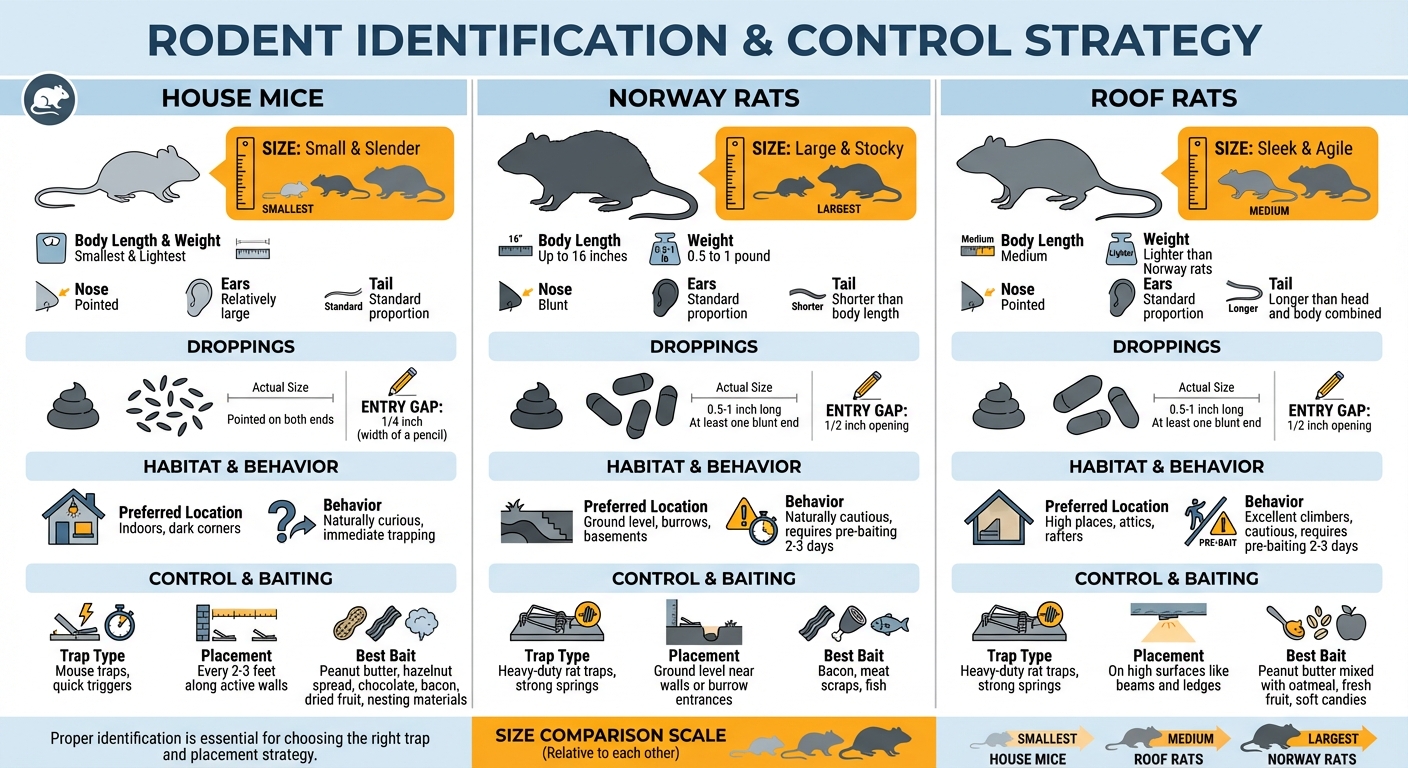
Rodent Identification Guide: Mice vs Norway Rats vs Roof Rats
Trap failure often comes down to using the wrong size for the target. As the University of California Agriculture and Natural Resources puts it: "You will not catch a rat with a mouse trap, and you will not catch a mouse with a rat trap".
The issue isn’t just size – it’s also about the trap’s force and mechanism. For example, a mouse trap doesn’t generate enough force to humanely or effectively capture a rat. On the flip side, rat traps are built with heavy-duty springs, but these springs can be too slow to catch quick-moving mice, sometimes failing to activate at all. Using the wrong trap can even make rats, which are naturally cautious, develop trap shyness. The next step? Learn how to identify your rodent correctly to ensure a proper match.
How to Identify Rodent Species
Before buying a trap, it’s crucial to identify the rodent causing the problem. Start with droppings – they’re often the first clue. Rat droppings are usually 0.5 to 1 inch long with at least one blunt end, while mouse droppings are much smaller and pointed. If you find both large and small droppings in one area, it could indicate a reproducing population.
Physical features provide more hints. Norway rats are large and stocky, growing up to 16 inches in length and weighing between 0.5 and 1 pound. They have blunt noses and tails shorter than their bodies. Roof rats, on the other hand, are sleeker and more agile, with pointed heads and tails that are longer than their head and body combined. House mice are small and slender, with pointed noses and relatively large ears.
Location is another clue. Roof rats are excellent climbers and prefer high places like attics, cabinets, and rafters. Norway rats stick closer to the ground, often burrowing near foundations or hiding in basements. House mice tend to nest indoors near food sources, favoring dark corners. Identifying the species accurately is essential for choosing the right trap.
Matching Traps to Species
Once you’ve identified the species, you can select the appropriate trap. Rat traps are much larger and equipped with heavy-duty springs for maximum impact, while mouse traps are smaller and designed with quick triggers to snap before a mouse can escape.
For rats, it’s helpful to pre-bait traps for two to three days without setting them. This allows the rats to overcome their natural wariness and begin taking the bait consistently. Mice, being naturally curious, usually don’t require this step and can often be trapped right away.
Placement also matters. For roof rats, set traps on high surfaces like beams and ledges. Norway rats require traps at ground level, near walls or burrow entrances. Position traps in a "T" shape along walls since rodents tend to stick to linear paths for cover.
Avoid using glue traps for adult rodents. These traps are more likely to catch juveniles because adult rodents have specialized guard hairs that detect subtle changes in texture, allowing them to avoid sticky surfaces. Additionally, the CDC advises using traditional snap traps instead of glue or live traps, as the latter can cause rodents to urinate in fear, increasing the risk of spreading pathogens.
Poor Trap Placement and Baiting
Even the most effective trap won’t work if it’s placed or baited incorrectly. These mistakes are common but easy to correct once you understand how rodents behave.
Where to Place Traps
Rodents tend to stick close to walls, where they feel safer. As Victor Pest explains:
Mice and rats travel alongside the edges of rooms to feel less vulnerable and to have more protection from potential threats.
This means traps placed in open spaces, like the middle of a room, are likely to be ignored.
For best results, position traps in a "T" shape with the trigger end facing the wall. This setup increases the chances of a rodent activating the trap as it follows its usual path. Look for high-activity areas marked by droppings, gnaw marks, grease smears (known as "sebum marks"), or urine stains – these are telltale signs of rodent runways.
Focus on undisturbed spots where rodents like to hide, such as behind appliances like refrigerators and stoves, inside cabinets, along basement walls, or in attics and crawlspaces. For mice, place traps every 2 to 3 feet along active walls, as they typically forage within 10 to 50 feet of their nest. Using multiple traps, especially on the first night, can improve your success rate since that’s when rodents are most likely to be caught.
To avoid transferring human scent to the traps, wear gloves while handling them. For added security, anchor traps in busy areas with wire or zip ties.
Once your traps are in the right spots, the next step is choosing bait that rodents can’t resist.
Selecting the Right Bait
Peanut butter is widely regarded as the top bait for both mice and rats. Its high fat content, strong aroma, and sticky texture make it hard for rodents to grab without triggering the trap. George Schulz, a registered technician at Better Termite and Pest Control, notes:
Peanut butter consistently ranks as the most effective mouse bait in professional pest control applications.
Different rodents have slightly different preferences, so tailoring your bait to the species can help. Here’s a quick guide:
| Rodent Species | Best Bait Options |
|---|---|
| House Mice | Peanut butter, hazelnut spread, chocolate, bacon, dried fruit, nesting materials (cotton/yarn) |
| Roof Rats | Peanut butter mixed with oatmeal, fresh fruit, soft candies |
| Norway Rats | Bacon, meat scraps, fish |
Use only a small amount – about the size of a pea. According to Victor Pest:
A pea-sized amount of mouse trap bait is just right – enough to attract mice, but not so much that they can eat it without springing the trap.
Too much bait allows rodents to nibble without setting off the trap.
In colder months, you might have better luck with nesting materials like cotton balls, dental floss, or yarn instead of food. Rodents tend to prioritize building nests when temperatures drop.
If a trap goes untouched for a week, try switching up the bait and eliminating other food sources like spilled pet food, open trash, or birdseed. This ensures the trap becomes the most appealing option for the rodents.
Ignoring Entry Points and Prevention
If you don’t seal entry points, your rodent problem will persist. Even if you trap a few, new ones will quickly take their place. As 10-Eleven Nuisance Wildlife Control puts it:
Exclusion is the foundation of all rodent control. If a home or building is not fully sealed, you will never eliminate the infestation.
Sealing Gaps and Cracks
Rodents are experts at squeezing through tiny spaces. Mice can fit through openings as small as 1/4 inch (about the width of a pencil), and rats need just 1/2 inch. These gaps are often found around utility lines, under sinks, in foundation cracks, along soffits, eaves, and near windows or doors.
Not all materials work for sealing these gaps. Avoid using spray foam, plastic weather stripping, rubber door sweeps, or expanding foam – rodents can easily chew through these.
Instead, use 1/4-inch steel mesh (hardware cloth) to cover vents and larger openings. For smaller holes, pack steel wool or copper mesh into the gaps and secure it with caulk to prevent rodents from pushing it aside. For larger spaces, use galvanized sheet metal (24-gauge or heavier) or cement. You can also install metal kick plates on doors and replace rubber sweeps with rodent-proof versions that include metal mesh.
| Entry Point | Where to Check | Best Sealing Material |
|---|---|---|
| Utility Lines | Pipes, electrical wiring, gas lines | Steel wool with caulk, metal flashing |
| Roof & Attic | Eaves, soffits, gables, vents | 1/4-inch hardware cloth |
| Foundation | Ground-level cracks, crawl space vents | Cement, hardware cloth, metal sheeting |
| Doors/Windows | Thresholds, gaps under doors | Metal kick plates, rodent-proof door sweeps |
Inspect areas like the roofline, behind appliances, inside cabinets, and along the foundation thoroughly.
But sealing gaps isn’t enough. You also need to get rid of easy food sources.
Removing Food Sources
Rodents won’t bother with traps if they have easier access to food. Store all food – including pet food, birdseed, and grass seed – in metal or thick plastic containers with tight lids, as rodents can chew through cardboard and thin plastic. NC State Extension underscores this point:
The only reliable ‘rat-proof’ storage is a solid metal container with a firm fitting lid.
Don’t leave pet food or water bowls out overnight – store them as soon as your pets are done eating. Keep your kitchen clean by wiping up grease under stove lids, clearing crumbs behind appliances, and emptying debris from toaster trays.
Outside, pick up fallen fruit daily, clean up birdseed spills, and scrub grease off grills. Also, fix leaky faucets and pipes, as standing water or condensation from appliances like refrigerators can provide rodents with the hydration they need.
Finally, keep woodpiles and compost bins at least 100 feet from your home. Trim back vegetation to create a gap between plants and your foundation – this removes the hiding spots rodents use to approach your house unnoticed.
Skipping Cleanup and Monitoring
Catching a rodent is just one step in solving the problem. Without proper cleanup and ongoing monitoring, you risk re-infestation and potential health hazards. Rodents are known carriers of over 35 diseases, which can spread through direct contact with their bodies, droppings, urine, or saliva – or even by inhaling contaminated air.
Safe Disposal and Cleaning
When it comes to cleaning up after rodents, never sweep or vacuum droppings. Doing so can send harmful particles into the air. Instead, spray the carcass and the affected area with a disinfectant solution (a mix of 1.5 cups of household bleach per gallon of water works well), and let it sit for 5 minutes before handling anything. Always wear rubber or plastic gloves for protection. For larger infestations, additional safety gear like coveralls, goggles, and a HEPA-filtered respirator is recommended.
Dispose of dead rodents by double-bagging them, sealing the bags tightly, and placing them in a covered trash can. Be aware that rodent carcasses can host secondary pests like fleas, ticks, and mites, which can spread diseases even after the rodent is gone. Wash any contaminated bedding in hot water and dry it on high heat. For carpets or upholstery, use a steam cleaner or a commercial-grade shampoo with disinfectant.
Once the area is disinfected and the rodents are disposed of properly, ongoing monitoring is critical to ensure the infestation is completely resolved.
Continued Monitoring After Trapping
Thorough cleanup works hand-in-hand with proper trap placement by removing scent markers that could attract new rodents. Check traps daily and continue monitoring for at least seven days after the last catch. If no new signs – such as droppings, gnaw marks, or rodent sightings – appear during this time, the infestation is likely under control. However, fresh signs indicate ongoing activity.
| Monitoring Sign | What It Means | What to Do |
|---|---|---|
| New Droppings | Active infestation | Clean the area and reset traps |
| Gnaw Marks | Active or past entry | Seal entry points and monitor closely |
| No catches for 7 days | Infestation likely resolved | Continue monitoring before removing traps |
Leaving behind urine, droppings, or other traces can attract new rodents through scent markers and pheromones. Regular monitoring ensures your exclusion efforts are effective and confirms that your space remains rodent-free.
Relying Only on DIY Methods
At first glance, DIY trapping might seem like a budget-friendly way to handle rodent problems. However, it often falls short, especially when faced with rodents’ rapid reproduction rates. Many homeowners misjudge the size of the infestation, focusing only on the visible rodents while larger populations continue thriving in hidden spaces like walls, attics, and crawl spaces.
Common DIY Trapping Problems
DIY methods come with their fair share of challenges, many of which reduce their overall effectiveness. For instance, rodents can detect human scent on traps, making them cautious. Choosing the wrong bait – or even using too much of it – can allow rodents to steal the bait without triggering the trap. Glue traps, while widely available, are not only inhumane but also tend to catch younger rodents, increasing the risk of disease transmission.
Trap placement is another common issue. Homeowners often place traps in open spaces, but rodents naturally stick to areas along walls where they feel safer. Additionally, rats are notoriously neophobic, meaning they shy away from unfamiliar objects in their environment. As Zachary Smith, Owner of Smith’s Pest Management, explains:
Rats follow scent trails everywhere they go and avoid things that don’t smell like them. If you put a new trap in their environment and it doesn’t smell like any rats have been in or on it before, the rats will just avoid it.
Using poisons as a DIY solution brings its own risks. Rodents may die in hard-to-reach spots, such as behind walls, causing foul odors and even secondary infestations. Snap traps, if placed incorrectly, can injure pets or children, while glue boards may unintentionally trap household pets or even non-target wildlife.
Because of these challenges, DIY methods often fail to address the full scope of an infestation, leaving hidden nests and breeding sites untouched.
Why Professional Services Work Better
Professional pest control services take a more comprehensive approach, tackling not just the visible infestation but also the root causes. Experts estimate that rodents are responsible for 20% to 25% of house and structure fires with undetermined causes in the U.S., often due to their habit of chewing through electrical wires. DIY solutions rarely address these hidden dangers or the structural weaknesses that allow rodents to enter in the first place.
Companies like Sparrow’s Pest Control perform detailed inspections to uncover entry points, food sources, and hiding spots that homeowners may miss. Their focus is on exclusion – sealing up the house with materials that rodents can’t chew through – rather than just relying on trapping. As EnviroPest puts it:
DIY products only deal with the rodents you directly target. They don’t solve how mice and rats got inside, why they stayed, or why they keep coming back.
Professional pest control services also have a deeper understanding of rodent behavior. They analyze the species, age, and sex of the rodents they catch to determine whether the breeding female has been removed or if the infestation is still active. Techniques like pre-baiting and rotating traps are used to counteract rodents’ neophobia and trap fatigue. With customized extermination plans, family- and pet-safe methods, and guarantees for satisfaction, professional services provide solutions that go far beyond what DIY methods can achieve.
When to Call Sparrow’s Pest Control

Sometimes, tackling a rodent problem on your own can lead to more frustration than results. If you’re noticing piles of droppings, multiple nests, or even several dead rodents, it’s a sign the infestation may have grown beyond what DIY traps can handle. Another clear indicator is if droppings, urine stains, or gnaw marks persist for more than a week, suggesting a larger population that requires professional expertise.
One particularly tricky scenario is when you’re only catching male rodents or juveniles, while breeding females remain elusive. This often points to a deeper, more established infestation that needs a targeted approach from experts.
Free Inspections and Tailored Solutions
When your best efforts aren’t enough, it’s time to consider professional help. Sparrow’s Pest Control offers free inspections to residents in Bellingham, WA, and nearby areas. Their team identifies the exact rodent species – whether it’s house mice, deer mice, Norway rats, or roof rats – and locates every possible entry point. This includes even the smallest gaps, like 1/4-inch openings for mice or larger, quarter-sized holes for rats.
Sparrow’s Pest Control doesn’t just stop at identification. They use Integrated Pest Management (IPM) techniques to address infestations while minimizing the use of poisons. This method combines thorough inspection, monitoring, and exclusion strategies to create a long-term solution. As Public Health – Seattle & King County explains:
IPM methods often use less poison and employ other techniques to control pests. A pest control operator should inspect, monitor and make recommendations for excluding rodents.
Their approach includes sealing structural vulnerabilities with sturdy materials like steel wool and heavy wire mesh, eliminating food sources, and placing traps strategically along rodent pathways – not just where activity is most visible.
Safe, Family-Friendly Solutions Backed by a Guarantee
Sparrow’s Pest Control prioritizes safety by using EPA-approved products and placing traps and baits in tamper-resistant stations or areas that are out of reach. Their team is certified by the Washington State Department of Agriculture (WSDA) as Commercial Applicators, ensuring they follow strict safety guidelines.
To give you peace of mind, their services include a 100% satisfaction guarantee. If rodents return between scheduled visits, Sparrow’s will handle it at no extra cost. Plus, with affordable monthly plans, you’ll benefit from ongoing protection rather than a temporary fix. Their comprehensive approach doesn’t just remove the rodents you see – it addresses the underlying conditions that drew them in the first place.
Conclusion
Getting rid of rodents successfully means steering clear of common missteps that can derail your efforts. For instance, using mouse traps to catch rats or setting traps away from walls is ineffective and wastes both time and money. Another mistake is poor baiting – using too much bait or opting for cheese instead of peanut butter often lets rodents grab the bait without triggering the trap. Additionally, leaving entry points unsealed allows new rodents to replace the ones you’ve caught. Addressing these errors is crucial for achieving lasting results.
Long-term rodent control involves more than just setting traps. It requires identifying the specific species, sealing all entry points, removing alternative food sources, and continuously monitoring for activity. As 10-Eleven Nuisance Wildlife Control explains:
Exclusion is the foundation of all rodent control. If a home or building is not fully sealed, you will never eliminate the infestation.
If you notice droppings persisting for over a week despite your efforts, it’s a strong indication that the infestation has grown beyond what DIY methods can handle. Professional services, like Sparrow’s Pest Control, offer free inspections, expert identification, and permanent exclusion solutions. Their Integrated Pest Management approach goes beyond just treating visible infestations – it addresses the root causes that attract rodents in the first place. By mastering these strategies, you can ensure a rodent-free home.
FAQs
How can I tell if I have mice or rats in my home?
To determine if you’re dealing with mice or rats, pay attention to differences in size, droppings, and types of damage. Rats are significantly larger, measuring 11–19 inches long (including their tail) and weighing between half a pound and a pound. They have coarse fur and a long, scaly, hairless tail. Mice, on the other hand, are much smaller – about 6–7 inches long (including their tail) – and weigh only around half an ounce. Their fur is finer, their ears are larger in proportion to their body, and their tails are thin and hairless.
Droppings can also help you identify the culprit. Mouse droppings are tiny, less than ¼ inch long, and pointed at both ends. Rat droppings, however, are larger – about ½ inch or longer – and their shape can vary depending on the species. The damage they cause is another clue: rats tend to gnaw larger holes (roughly the size of a quarter), while mice leave smaller, dime-sized holes. Other signs include oily rub marks, gnawed objects, or a distinct urine odor that can help you locate the infestation.
If you’re uncertain or need assistance with an infestation, Sparrow’s Pest Control provides professional rodent removal services in Bellingham, WA, and nearby areas. Their experts can identify the issue and deliver safe, effective solutions to protect your home.
What’s the most effective way to place traps for catching rodents?
To catch rodents effectively, place traps in areas where you’ve noticed activity – look for signs like droppings, gnaw marks, or well-worn paths. Rodents tend to stay close to walls and prefer dark, hidden spots, so it’s smart to position traps along baseboards, under furniture, or inside closets where they feel most secure.
For better results, set traps in pairs with the triggers facing the wall. This setup aligns with the natural paths rodents follow. Always keep traps out of reach of children and pets, and check them often to either rebait or remove any caught rodents. Success comes down to thoughtful placement and regular upkeep.
Why is it important to seal entry points when dealing with rodents?
Blocking entry points is one of the most effective ways to keep rodents out of your home or building. Mice and rats can squeeze through surprisingly small gaps or cracks, so sealing these off significantly lowers the risk of an infestation.
When you close off these access points, you not only prevent rodents from getting in but also improve the effectiveness of other control methods, like traps or bait. With fewer rodents entering, these tools can work more efficiently. This simple yet essential step helps safeguard your property and ensures your living space stays clean and rodent-free.