
Fleas in your home? Identifying the species is the first step to solving the problem. Different fleas – like cat fleas, dog fleas, or wildlife-related fleas – require specific treatments. Here’s what you need to know:
- Cat fleas (Ctenocephalides felis) are the most common, affecting both cats and dogs.
- Dog fleas (Ctenocephalides canis) are rare in the U.S. but similar to cat fleas.
- Human fleas (Pulex irritans) primarily target people and lack combs on their bodies.
- Sticktight fleas (Echidnophaga gallinacea) prefer birds but can bite humans.
The Pacific Northwest’s mild climate allows fleas to thrive year-round, making infestations a persistent issue. Fleas can cause itching, allergic reactions, and even transmit diseases like cat-scratch fever or typhus. Proper identification ensures safe and effective pest control for your pets and family.
Quick Tip: Use a flea comb, inspect pets and their bedding, and look for flea dirt (black specks that turn red on wet paper). If DIY solutions fail, professional pest control in Bellingham can help.
Different Types of Fleas
sbb-itb-be66415
Why Identifying Flea Species Matters in Bellingham
Identifying flea species is crucial for choosing professional flea control treatments that align with both the local environment and specific health risks. Knowing the type of flea you’re dealing with ensures the pest control methods you use are both effective and safe for your situation.
Climate and Environment in the Pacific Northwest
Bellingham’s mild winters and humid conditions create an ideal environment for fleas to thrive year-round. While flea activity typically peaks between spring and fall, the region’s weather allows these pests to remain active even during the colder months. For homeowners, this means fleas are not just a seasonal issue – they’re a constant concern.
The Pacific Northwest’s natural surroundings also contribute to flea diversity. Shaded areas where pets or wildlife rest often become breeding grounds for fleas. Additionally, certain species can indicate hidden infestations in spaces like attics or crawlspaces. These environmental factors not only increase flea populations but also elevate the risks they pose to both pets and humans.
Health Risks for Pets and People
The persistent presence of fleas in Bellingham brings a variety of health risks. Different flea species carry unique threats. For example, cat fleas are notorious for causing itchy bites and allergic reactions, while other species, like the Oriental rat flea, are known to transmit more severe diseases, such as plague – though human cases of this are extremely rare, with the last recorded instance in 1984.
Some of the most common health issues include cat-scratch fever and flea-borne typhus, both of which are spread by cat fleas. It’s worth noting that around 40% of cats carry Bartonella henselae, the bacteria responsible for cat-scratch fever, at some point in their lives. According to King County Public Health:
While their bites can cause severe itching and skin infections, they can also spread diseases such as cat-scratch fever, typhus and plague to people.
In addition to transmitting diseases, flea bites can cause significant physical discomfort. Scratching at bites may lead to secondary skin infections. Allergic reactions can vary widely, from mild irritation to severe, life-threatening symptoms in particularly sensitive individuals. Identifying the specific flea species is essential for determining the right treatment plan and for understanding whether the infestation stems from pets or wildlife.
Common Flea Species in the Pacific Northwest
The Pacific Northwest is home to several flea species, with cat and dog fleas being the most prevalent. Identifying the specific flea species is key to selecting effective treatments and determining whether the infestation stems from household pets or local wildlife.
Cat Flea (Ctenocephalides felis)
The cat flea is the most widespread flea species across North America. Despite its name, it infests both cats and dogs and occasionally bites humans. According to WSU Entomology:
"The cat flea, Ctenocephalides felis is the most important flea in much of the U.S. as it can reproduce on both dogs and cats and occasionally bites humans."
These fleas are small, measuring 3–4 mm, and have a reddish-brown to black, flattened body that allows them to navigate through fur with ease —a physical trait they share with other pests like bed bugs. Their elongated head is equipped with distinctive "combs" (ctenidia) on both the head and thorax. Female cat fleas are prolific, laying 30–50 eggs daily directly on their host. Adults typically live for 4 to 25 days, and their impact is significant – flea-related veterinary costs in the U.S. total approximately $2.8 billion annually.
Dog Flea (Ctenocephalides canis)
Dog fleas are less common in the Pacific Northwest and the United States overall, as most fleas found on dogs in North America are actually cat fleas. However, they are more prevalent in Europe. Dog fleas are nearly identical to cat fleas in size (3–4 mm) and color but can be distinguished by their more rounded head shape. Additionally, they have eight notches on their tibiae compared to the six notches found in cat fleas. Field identification between the two species is difficult without magnification.
Human Flea (Pulex irritans)
Human fleas are less common in industrialized areas but primarily target humans. What sets this species apart is the absence of combs (ctenidia) on the head and thorax, along with their broadly rounded head shape. These features make them distinct from cat and dog fleas.
Sticktight Flea (Echidnophaga gallinacea)
Sticktight fleas are typically found on birds and poultry, making them a concern for properties with coops or active bird nesting. They are named for their habit of attaching firmly to their host’s skin, often around the eyes, comb, and wattles of birds. While they prefer avian hosts, they can bite humans who come into close contact with infested birds. If fleas are found near bird nesting areas or poultry housing, sticktight fleas may be the culprit.
Recognizing the unique characteristics of each flea species is essential for accurate identification and effective treatment, as outlined in the inspection guide that follows.
Physical Traits for Identifying Fleas
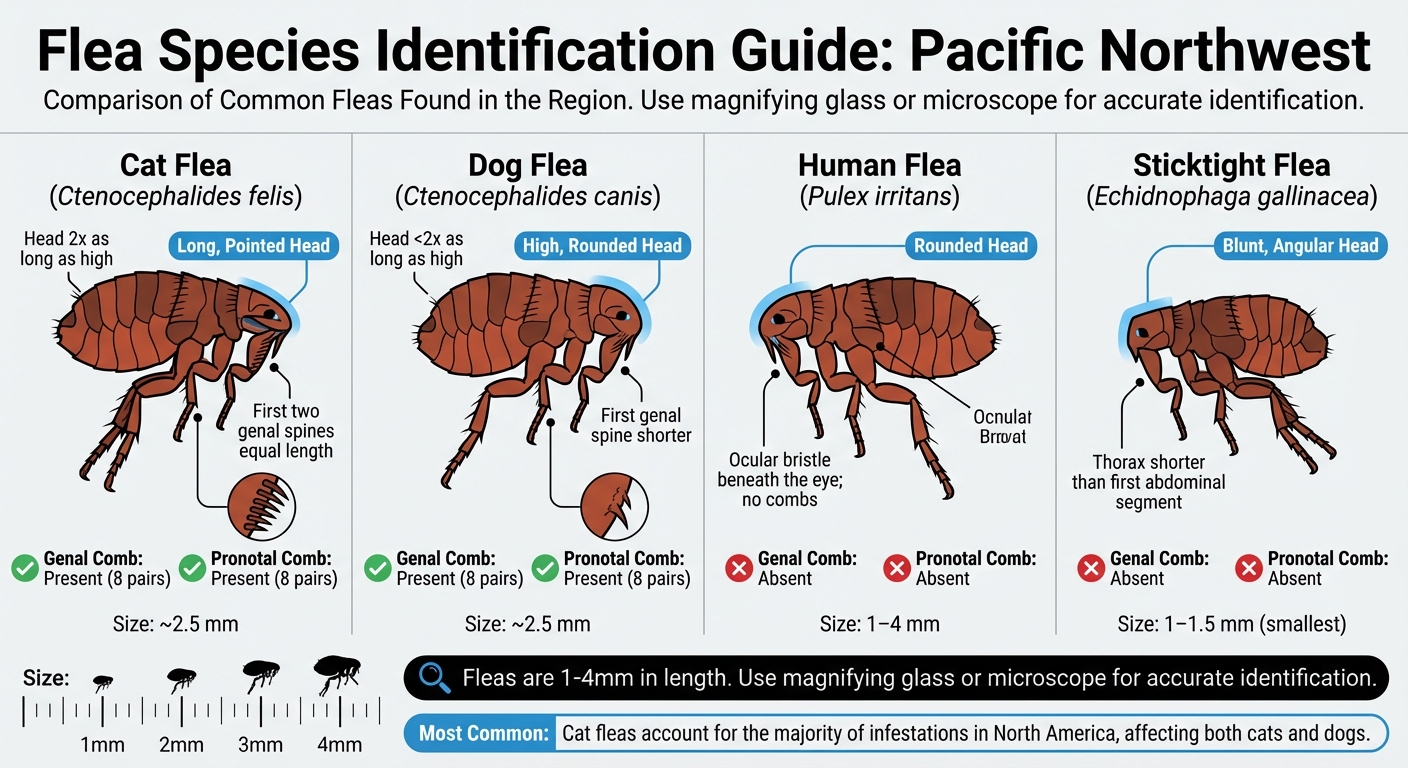
Visual Guide to Identifying Common Flea Species in the Pacific Northwest
Fleas are tiny, measuring between 1–4 mm in length, with wingless, flattened bodies that allow them to move easily through fur or feathers. Their piercing-sucking mouthparts and strong hind legs make them incredible jumpers, capable of leaping up to 200 times their body length – about 7 inches vertically and 13 inches horizontally.
To identify different flea species, one of the most reliable methods is to examine their combs (ctenidia). These are the sturdy spines located on the head (genal comb) or the first thoracic segment (pronotal comb). Since fleas are so small, identifying these features often requires a magnifying glass or microscope. Entomologists sometimes use lactic acid to "clear" specimens, making the combs easier to see.
Head shape is another important identifier. Cat fleas have elongated heads, while dog and human fleas have rounded heads, and sticktight fleas feature a blunt, angular head. The arrangement and length of the comb spines also vary by species. For example, cat fleas have equal-length first and second genal spines, whereas dog fleas have a noticeably shorter first spine.
The table below provides a quick comparison of key features across common flea species.
Flea Species Comparison Table
| Flea Species | Size | Genal Comb | Pronotal Comb | Head Shape | Identifying Feature |
|---|---|---|---|---|---|
| Cat Flea | ~2.5 mm | Present (8 pairs) | Present (8 pairs) | Long and pointed | First two genal spines equal; head 2× as long as high |
| Dog Flea | ~2.5 mm | Present (8 pairs) | Present (8 pairs) | High and rounded | First genal spine shorter; head <2× as long as high |
| Human Flea | 1–4 mm | Absent | Absent | Rounded | Ocular bristle beneath the eye |
| Sticktight Flea | 1–1.5 mm | Absent | Absent | Blunt and angular | Very small; thorax shorter than first abdominal segment |
These physical traits are essential for identifying flea species, especially in Bellingham’s specific climate conditions.
For field identification, use a fine-toothed flea comb to collect samples from areas like your pet’s belly or behind the ears. Drop the captured fleas into soapy water to immobilize them, then inspect them with a magnifier. Additionally, check your pet’s fur for dark specks of flea dirt (dried blood). If these specks turn red when placed on a wet paper towel, you’ve confirmed fleas are present. Use these observations as a starting point for a detailed identification process.
How to Identify Flea Species: Step-by-Step
To identify flea species effectively, you’ll need to gather and examine specimens from your pets and home. With the right tools and techniques, you can pinpoint the specific flea species causing trouble. Here’s how to proceed.
Checking Pets and Indoor Areas
Start by inspecting your pets, paying close attention to areas where fleas typically hide. Focus on spots with less hair, like the groin and belly, as well as hard-to-reach areas such as behind the hindquarters. Use a fine-toothed flea comb, combing against the grain (toward the pet’s head) to catch fleas and flea dirt.
For indoor inspections, try the white socks test. Walk through carpeted rooms wearing light-colored pants and white socks pulled up to your cuffs. Fleas will jump onto the fabric, making them easy to spot against the light background. Additionally, inspect common resting areas like pet bedding, furniture, and floors – places your pet frequents most.
Tools for Close Inspection
Once you’ve collected specimens, it’s time for a closer examination. Use a flea comb to capture fleas, and immediately submerge them in soapy water or rubbing alcohol to prevent them from escaping. Begin by examining the specimens with a magnifying glass, then use a microscope to study finer details like the head shape and comb arrangement.
Cornell University College of Agriculture and Life Sciences highlights the importance of this step:
Flea species can be identified to determine what host brought in the flea, but a microscope will be needed to distinguish the various flea species using pictorial keys.
Another effective method is setting up an overnight trap. Place a desk lamp over a shallow pan of soapy water. The heat and light attract fleas, which jump toward the light and drown in the water.
Recording and Comparing Your Findings
After thoroughly inspecting and collecting specimens, document your observations. Use magnification tools to note key features like head shape and the presence of combs. Compare these observations with the species comparison table included earlier in this guide. If you’re still unsure, reach out to your local cooperative extension service or a Bellingham pest control experts for assistance.
Keep detailed records of your findings, including notes or photos. This information is particularly useful if infestations occur repeatedly. Knowing whether you’re dealing with a common domestic flea or one associated with wildlife, such as the Oriental rat flea, can help you trace the source of the infestation and choose the most effective treatment plan.
When to Call a Pest Control Professional
Signs of a Serious Infestation
Sometimes, flea problems escalate beyond what DIY methods like vacuuming, washing bedding, or using sprays can manage. If these efforts don’t resolve the issue and fleas persist, it’s time to call in the professionals. As Environmental Pest Control emphasizes:
"Flea infestations do not go away on their own. If you are experiencing a significant infestation, prompt action is recommended to safely treat your home, business, or property."
Look for telltale signs like flea dirt on carpets and furniture. If your pets are scratching excessively, losing hair, or showing signs of irritated, reddened skin, the problem might already be advanced. Similarly, clusters of itchy red bites on human ankles and lower legs are a clear indicator that fleas have spread beyond your pets.
Wildlife can also play a role in persistent flea issues. Animals like raccoons, squirrels, or opossums nesting in your attic or crawlspace may be introducing fleas into your home repeatedly. In these cases, professional wildlife control is critical – not just to remove the animals but also to seal entry points and eliminate the source of the infestation. Identifying the specific flea species is another step that helps pest control experts address both household and wildlife-related infestations. The University of Minnesota Extension highlights this advantage:
"Their knowledge and experience plus a larger assortment of products allow pest management companies to control fleas more effectively."
Another challenging aspect of flea control is dealing with the pupal stage. As G Green Inc. Pest and Wildlife Management explains:
"Flea pupae are protected by a cocoon, which makes them resistant to many treatments. These pupae can survive through most chemical controls and will only emerge as adults once they hatch."
This resistance makes standard bug bombs and foggers largely ineffective, as they often fail to reach the hidden areas where pupae develop. If you notice these signs or suspect fleas are resisting your efforts, it’s time to seek professional help.
Sparrow’s Pest Control Services

For those in Bellingham and nearby areas, Sparrow’s Pest Control offers specialized flea extermination services tailored to the unique challenges of the Pacific Northwest. Their team understands the local pest issues and how Bellingham’s climate influences flea activity. They operate under the belief that:
"A flea problem is a home problem, not just a pet problem. The only way to stop the cycle is with a professional flea extermination service that treats your entire home."
Their approach includes a three-step process. First, they conduct a detailed inspection to identify flea species, nesting spots, and entry points. Next, they create a customized extermination plan using EPA-approved products and Integrated Pest Management techniques to target fleas at every stage of their lifecycle. Finally, follow-up visits and prevention tips help ensure fleas don’t return.
Sparrow’s uses treatments that are safe for families and pets, and they back their services with a 100% satisfaction guarantee, offering free re-treats if needed. They also provide free inspections and estimates for residents in Bellingham.
Their Premium Plan, priced at $59/month for homes under 2,500 sq. ft., includes quarterly flea and tick treatments for both indoor and outdoor spaces. Whether you’re dealing with an active infestation or preparing a rental property previously occupied by pets, professional services like these are essential to breaking the flea life cycle.
Conclusion
Identifying flea species plays a key role in effective pest control, especially in Bellingham. Whether you’re dealing with cat fleas, rodent-associated fleas, or another species, knowing the type helps trace the infestation’s origin and choose treatments that actually work.
The mild, moist climate of the Northwest allows fleas to thrive year-round, making accurate identification even more critical. Different flea species carry different health risks. For instance, cat fleas can transmit tapeworms and cat-scratch disease, while rodent-associated fleas may carry more severe pathogens. In Washington, fleas can even spread plague from wild rodents, highlighting the public health importance of identifying the species involved. This connects back to earlier points about how climate and health risks intersect.
Although there are around 2,500 flea species, only a handful pose threats to human health. Proper identification ensures pest control efforts are targeted and effective, especially in homes without pets. As noted by Cornell University Cooperative Extension:
Accurate insect identification is critical for flea management because bites produced by fleas cannot be distinguished from the bites of other arthropods, including bed bugs, mosquitoes or mites.
Without precise identification, pest control can waste both time and resources.
If DIY solutions don’t resolve the issue or the flea species remains unknown, it’s time to bring in a professional. Sparrow’s Pest Control (https://www.sparrowspestcontrol.com) provides detailed inspections and tailored treatment plans that are safe for both families and pets. Their approach ensures the infestation is addressed at its source from the very beginning, tying together all the earlier recommendations into a clear and actionable solution.
FAQs
Are these fleas coming from my pets or wildlife?
Fleas in Bellingham, WA, often originate from both household pets and local wildlife. Common types, like cat fleas and dog fleas, typically infest cats and dogs but don’t hesitate to bite humans as well. Wildlife such as raccoons and rodents can introduce fleas into your yard or even inside your home. Additionally, fleas can tag along on clothing or other objects, making prevention and a well-rounded pest management approach essential for keeping infestations under control.
Do I need a microscope to identify flea species?
You don’t always need a microscope to identify flea species. Traits like size, color, body shape, and movement are often noticeable with just your eyes or a magnifying glass. That said, a microscope can come in handy for more detailed identification work. Pay attention to these visible features to spot common flea species in the Pacific Northwest.
Why do fleas keep coming back in Bellingham?
Fleas are a persistent issue in Bellingham, thanks to their quick reproduction and the area’s favorable conditions. A single female flea can lay hundreds of eggs, which often settle into carpets, pet bedding, or shaded outdoor spaces like backyards. These eggs develop into larvae and pupae, setting the stage for reinfestations.
To tackle this problem, consistent efforts are key. Regular vacuuming, washing your pet’s bedding, maintaining your yard, and enlisting professional pest control services – such as those provided by Sparrow’s Pest Control – can help disrupt the flea life cycle and keep them from coming back.