
Pesticide violations in Washington can lead to serious penalties, including fines up to $7,500 per violation. The Washington State Department of Agriculture (WSDA) enforces these regulations to protect public health and ensure safe pesticide use. Key violations include unlicensed applications, improper pesticide use, and record-keeping failures. Penalties escalate for repeat offenses, with harsher fines and license suspensions for cases involving human exposure or probable harm.
Key Points:
- Maximum Fine: $7,500 per violation.
- Human Exposure: Fines start at $1,500 + 5-day license suspension.
- Unlicensed Applicators: First offense fines start at $2,500.
- Record-Keeping: Missing or incomplete records can lead to fines.
To avoid penalties, always hire licensed professionals, follow pesticide labels, and maintain accurate records. Licensed providers, like Sparrow’s Pest Control, ensure compliance with WSDA standards, reducing risks of violations.
Common Pesticide Violations and Examples
Unlicensed Pesticide Applications
Applying pesticides without proper licensing from the Washington State Department of Agriculture (WSDA) comes with steep penalties. Whether it’s applying pesticides, distributing restricted-use products, or offering consultation services without a license, violators can face immediate fines. For commercial applicators, a first offense results in a base fine of $2,500, while a second offense increases the penalty to $5,000, and a third offense can climb to $7,500. Unlicensed pesticide dealers also face penalties, with fines starting at $1,000 for a first violation.
Licensing ensures that applicators are trained and capable of handling pesticides safely. WSDA licenses must be renewed and kept up to date every five years, and any changes should be reported within 30 days. These requirements are not just about avoiding fines – they’re critical for protecting public health and the environment.
Improper Label Use and Misapplication
Common violations include applying pesticides at rates higher than recommended, using them in restricted areas, or applying them to crops not listed on the product label. For example, a first-time violation can result in a $300 fine, and if pesticide drift causes probable harm, penalties can escalate to $1,000 along with a four-day suspension.
"Misuse of pesticides can occur if pesticides drift off target and cause damage to non-target plants, animals, or human health".
Drift violations are among the most frequent issues investigated. These often happen when applicators fail to account for weather conditions or neglect to adjust their equipment properly. Understanding the risks of misapplication and taking steps to prevent drift can help avoid penalties. Additionally, maintaining accurate records of application methods is crucial for demonstrating compliance.
Record-Keeping and Reporting Failures
Certified applicators in Washington – and those treating over one acre of agricultural land – are legally required to document every pesticide application in detail. These records play a key role in WSDA investigations. Applicators must complete and retain records on the same day of application and keep them for seven years.
The required records must include 14 specific details, such as the product name, EPA registration number, wind direction and speed, temperature, total amount applied, and the exact site or crop treated. If the WSDA requests these records in writing, applicators are obligated to provide copies immediately. Failing to maintain or provide accurate records can lead to escalating fines. Inspectors may also request to review both records and application equipment during investigations. Keeping comprehensive records is not only a legal requirement but also a key way to demonstrate compliance and avoid penalties.
WSDA Penalty Structure and Maximum Fines
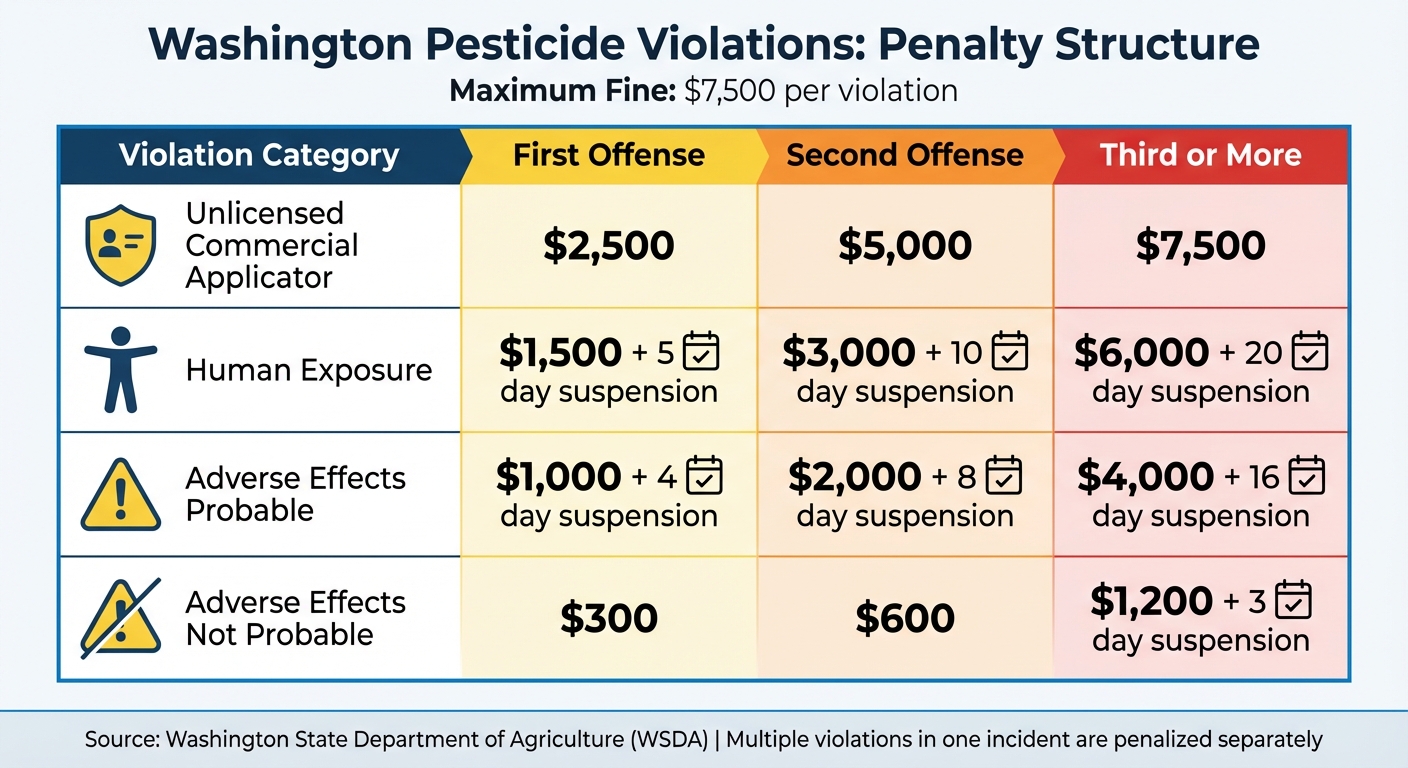
Washington State Pesticide Violation Fines and Penalties by Offense Level
How Penalties Are Calculated
The Washington State Department of Agriculture (WSDA) relies on a standardized penalty matrix to determine fines. This matrix adjusts a base penalty based on the severity of the violation, whether it’s a repeat offense, and any aggravating or mitigating factors. For example, aggravating circumstances can lead to higher penalties, while cooperation with the WSDA might result in reduced fines. If multiple infractions occur during a single incident, each is penalized separately. Beyond monetary fines, penalties can also include license suspension, denial, or even revocation.
Understanding how these penalties are calculated is critical for managing risks and staying compliant. Following proper protocols for licensed services is a straightforward way to avoid these penalties altogether.
Maximum Fines for Violations
In Washington, the maximum civil penalty for a single pesticide violation is $7,500. If multiple violations happen during the same incident, each violation can be fined separately, up to this maximum amount.
| Violation Category | First Offense | Second Offense | Third or More |
|---|---|---|---|
| Unlicensed Commercial Applicator | $2,500 | $5,000 | $7,500 |
| Human Exposure | $1,500 + 5-day suspension | $3,000 + 10-day suspension | $6,000 + 20-day suspension |
| Adverse Effects Probable | $1,000 + 4-day suspension | $2,000 + 8-day suspension | $4,000 + 16-day suspension |
| Adverse Effects Not Probable | $300 | $600 | $1,200 + 3-day suspension |
Violations involving human exposure are treated with particular seriousness. A first offense in this category includes a $1,500 fine and a mandatory five-day license suspension. By the third offense, penalties escalate to a $6,000 fine and a 20-day suspension, with potential license revocation. The WSDA also has the flexibility to adjust the balance between fines and suspensions. For example, they may increase one while reducing the other if they believe it will better prevent future violations.
This structured approach to penalties lays the groundwork for examining real-world case outcomes in the following section.
Penalty Cases in Washington
Case Examples and Outcomes
The Washington State Department of Agriculture (WSDA) keeps detailed public records of pesticide enforcement actions, ensuring transparency in how violations are addressed across the state. Many of these enforcement actions begin with complaints about pesticide drift. To investigate, WSDA inspectors gather a wide range of evidence, including soil, vegetation, water, and clothing samples, alongside application records, maps, and weather data. This thorough process helps verify whether proper protocols were followed. When violations are confirmed, penalties are assigned based on a standardized matrix, treating each infraction as a distinct offense. These records demonstrate the consistent use of WSDA’s penalty framework.
"Regulatory action is necessary to deter violations of the pesticide laws and rules, and to educate persons about the consequences of such violation(s)."
– Washington Administrative Code
In cases where violations are intentional and driven by economic gain, the department can impose penalties exceeding the standard matrix. This policy ensures that companies cannot simply absorb fines as a routine cost of doing business.
Lessons from Past Violations
Looking back at past cases reveals valuable insights for compliance. Today, enforcement efforts focus heavily on encouraging voluntary compliance through education and technical support, while reserving strict penalties for repeat offenders.
"The most effective way to protect people and the environment from pesticide exposure is through voluntary compliance with these laws."
– Washington State Department of Agriculture
One of the clearest takeaways is that even a single day of multiple violations can result in fines reaching tens of thousands of dollars. Businesses that neglect licensing requirements, worker safety measures, or proper application procedures often learn the hard way that cutting corners leads to much higher costs in the long run – both financially and in terms of reputation. These cases highlight the importance of maintaining proper licensing, accurate record-keeping, and safe pesticide practices to avoid severe penalties.
If you suspect pesticide misuse, you can report it to WSDA by calling 1-844-388-2020.
sbb-itb-be66415
How to Comply and Avoid Fines with Licensed Services
The Role of Licensed Professionals
Licensed professionals play a crucial role in protecting you from hefty fines and compliance headaches. In Washington, these experts are required to complete initial training and renew their certification every five years to stay updated on state regulations. This ensures they have the knowledge to apply pesticides safely and legally.
By hiring licensed professionals, you effectively shift the burden of compliance to those who are trained to handle it. This can save you from penalties, such as fines starting at $1,500 and a mandatory five-day license suspension for incidents involving human exposure.
To ensure you’re working with a qualified provider, use the WSDA Licensing Search tool, which is updated daily. Make sure the license classification matches your specific needs, whether you require a pest control operator, ornamental sprayer, or structural pest inspector.
Benefits of Choosing Sparrow’s Pest Control
Sparrow’s Pest Control, based in Bellingham, WA, offers fully licensed pest control services that meet all state compliance standards. Their team keeps detailed application records, including the location, date, time, product information, EPA number, and applicator details, ensuring they align with WSDA requirements. This meticulous recordkeeping helps reduce the risk of non-compliance penalties.
The company prioritizes family- and pet-safe methods, using EPA-approved products to minimize the risk of human exposure. Their services include thorough inspections, customized extermination plans, and follow-up prevention strategies – all at competitive prices. They also offer a 100% satisfaction guarantee, addressing any compliance concerns swiftly to prevent minor issues from escalating.
With consistent service and ongoing monitoring, Sparrow’s Pest Control not only keeps pests at bay but also helps you maintain compliance without added stress.
Preventative Measures for Long-Term Compliance
While hiring licensed professionals is a great start, maintaining long-term compliance requires a proactive approach. Licensed providers stay on top of regulatory updates and insurance requirements, ensuring their services remain aligned with the latest standards.
For property owners, setting up a regular service schedule – such as quarterly treatments – can make a big difference. This approach allows for consistent monitoring and reduces the likelihood of emergency applications, which may skip necessary protocols. Always request service records to document compliance. If you suspect pesticide misuse, report it to the WSDA immediately.
Another key practice is monitoring weather conditions before pesticide applications. Weather-related issues, like off-target drift, are a common cause of WSDA investigations. Licensed professionals are trained to document environmental factors during applications, creating a reliable record that can protect you if any questions arise later.
Conclusion
Washington’s pesticide regulations are designed to protect both public health and the environment. Violators face fines of up to $7,500 per incident, alongside potential license suspensions or revocations for repeated infractions during a single event.
The WSDA penalty matrix plays a key role in enforcing compliance. It not only penalizes violations but also discourages future offenses by scaling fines based on the severity of the violation and whether it’s a repeat occurrence. First-time violations carry hefty fines, and penalties increase significantly for subsequent offenses. This structure highlights that prevention is far less costly than dealing with the aftermath of non-compliance.
Working with licensed professionals shifts the compliance burden to certified experts who are trained to follow regulations, maintain meticulous records, and use approved practices. For instance, Sparrow’s Pest Control offers fully licensed services that align with WSDA standards, utilize EPA-approved products, and ensure proper documentation for inspections.
For property owners, whether managing commercial or residential spaces, proactive compliance is non-negotiable. Verifying licenses, adhering to pesticide label instructions, and keeping thorough application records are critical steps. Partnering with licensed providers like Sparrow’s Pest Control ensures adherence to WSDA regulations, helping to avoid costly fines and legal issues tied to pesticide misuse.
FAQs
What are the most common pesticide violations in Washington State?
The most frequent pesticide-related violations in Washington State are operating or selling pesticides without the proper license and failing to comply with Worker Protection Standards (WPS). WPS violations typically involve issues like inadequate worker training, not providing the required personal protective equipment (PPE), or neglecting to offer emergency assistance or decontamination supplies.
To steer clear of these violations, it’s crucial to stay aligned with state regulations, offer comprehensive training to employees, and ensure all safety protocols are in place. Keeping up-to-date with pesticide laws not only safeguards your workers and the environment but also protects your business.
How are fines for pesticide violations in Washington determined?
In Washington, the Washington State Department of Agriculture (WSDA) calculates fines for pesticide violations using a structured approach. The process begins with a base penalty, which typically falls between $2,500 and $7,500 for licensing-related violations. From there, adjustments are made based on several factors, such as the seriousness of the violation, whether it’s a first-time or repeat offense, and any aggravating or mitigating circumstances. It’s important to note that the maximum fine for a single violation is $7,500.
The best way to avoid these fines? Stay compliant with all pesticide regulations and ensure your licensing is up to date. For added peace of mind, you might consider working with professionals like Sparrow’s Pest Control. They emphasize safe, regulation-compliant pest management practices to safeguard your family, pets, and the environment.
Why should I hire a licensed professional for pesticide applications in Washington?
When it comes to pest control in Washington, hiring a licensed pesticide professional isn’t just a smart choice – it’s essential for safety, compliance, and effective results. Licensed applicators go through specialized training and certification, equipping them to handle pesticides responsibly while adhering to strict state laws. This ensures the protection of people, pets, and the surrounding environment. Plus, they follow detailed record-keeping and notification rules that help minimize risks like accidental exposure or misuse.
On the other hand, hiring an unlicensed individual can lead to serious consequences. First-time violations can result in fines of up to $7,500, with steeper penalties for repeat offenses. Licensed companies, such as Sparrow’s Pest Control in Bellingham, WA, not only meet these legal standards but also carry the required liability insurance. This means they’re prepared to handle treatments properly and in line with state regulations.
By choosing a certified professional, you’re not just avoiding hefty fines – you’re also investing in safer, more reliable pest control solutions that give you peace of mind.