
Washington State enforces strict pesticide safety training and licensing standards to protect workers, communities, and natural resources. Here’s what you need to know:
- Annual Training for Agricultural Workers: Employers must provide pesticide safety training annually if workers operate in treated areas within 30 days. Records must be kept for two years.
- Licensing Types: Includes Commercial Applicators ($250/year), Private Applicators ($45/year), and more. Starting January 1, 2026, new categories like Space Fumigation and Aerial Pest Control require additional exams.
- Certification Process: Most licenses require passing the Washington Laws and Safety exam and category-specific tests. Fees range from $25 to $58 per exam.
- Worker Protection Standard (WPS): Covers hazard communication, exposure routes, PPE usage, and emergency response. Employers must ensure compliance and maintain detailed training records.
- Recertification: Applicators must earn credits every five years (e.g., 40 credits for most licenses, 20 for Private Applicators). Credits have annual limits and cannot roll over.
- 2026 Updates: New federal Certification & Training (C&T) rules require a one-hour course or quiz for license renewal. Businesses handling restricted-use pesticides must revise supervision protocols.
Compliance is mandatory to avoid penalties, ensure safe pesticide use, and maintain licensure. Stay updated through WSDA resources or consult with Bellingham pest control experts and plan training early to meet deadlines.
Certification and Training (C&T) Rule Changes Overview 2025
sbb-itb-be66415
Washington State Pesticide Licensing and Certification
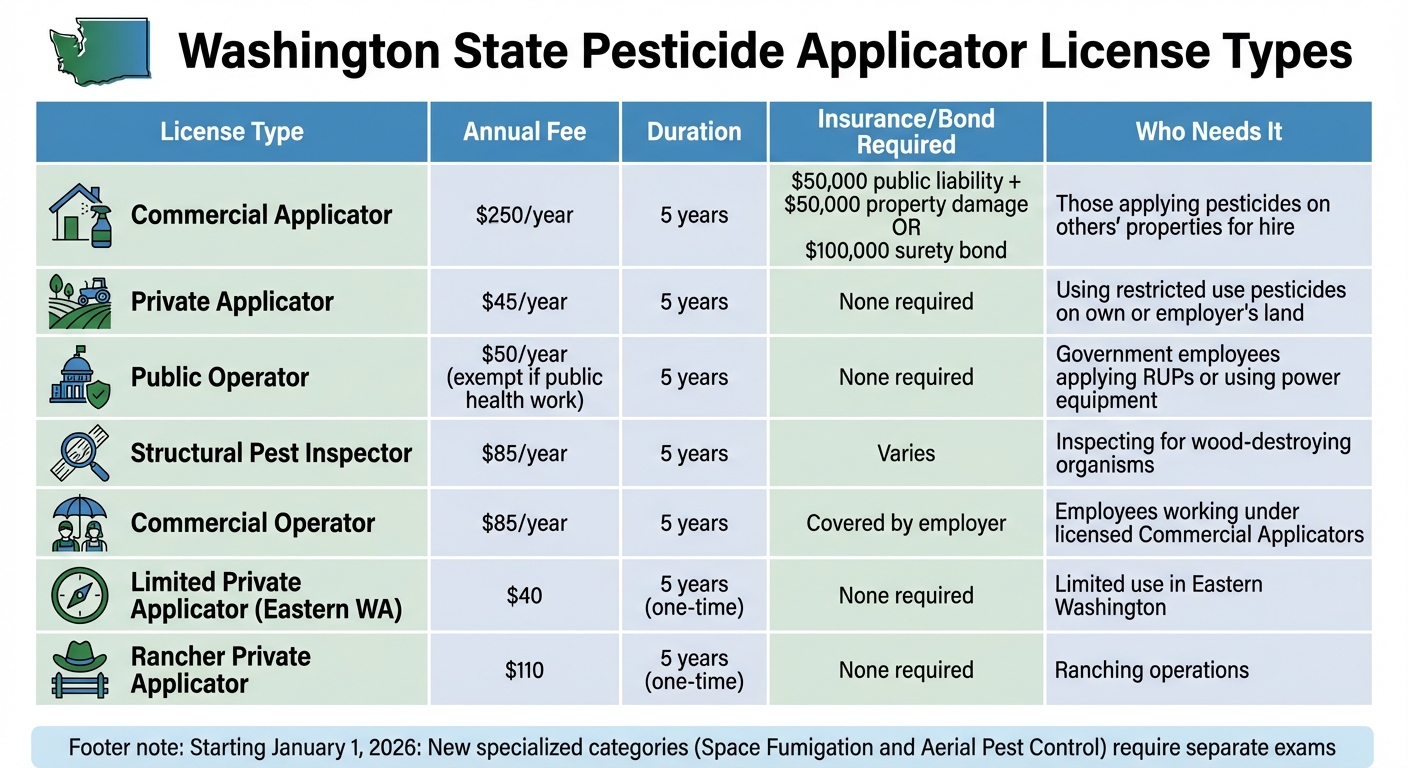
Washington State Pesticide License Types, Fees, and Requirements Comparison Chart
Types of Applicator Licenses
Washington provides various pesticide applicator licenses tailored to specific roles and employment situations. For instance, Commercial Applicators – those applying pesticides on others’ properties for hire – pay an annual fee of $250. They must also provide proof of either liability insurance ($50,000 for public liability and $50,000 for property damage) or a $100,000 surety bond [6, 9]. Private Applicators, who use restricted use pesticides (RUPs) on their own or their employer’s land, pay $45 annually. Meanwhile, Public Operators, typically government employees applying RUPs or using power equipment, are charged $50 annually, though they are exempt if performing public health work [8, 9].
Other license types include Structural Pest Inspectors, who inspect for wood-destroying organisms, and Commercial Operators, employees working under licensed Commercial Applicators – both of whom pay $85 annually. In Eastern Washington, Limited Private Applicators pay $40 for a five-year license, while Rancher Private Applicators pay $110 for the same period.
Starting January 1, 2026, two new specialized categories will require separate exams: Space Fumigation and Aerial Pest Control. Once you determine which license fits your needs, you can begin the certification process.
How to Get Certified
Certification is not just a legal requirement – it’s also essential for ensuring safe pesticide application practices. To start, use the WSDA "Pesticide License Decision Tree" to identify the license type that aligns with your work. Most licenses require passing the Washington Laws and Safety exam along with at least one category-specific test, such as Weed Control or Insect and Disease Control. However, Private Applicators have the option of taking the Private Applicator exam instead or completing the Laws and Safety exam plus both category exams [9, 10].
You can choose between paper-based testing, which costs $25 per session, or computer-based exams at $58 per test. Be sure to bring a government-issued photo ID to the testing site. If you’re applying as a Commercial Applicator, you’ll also need a Unified Business Identifier (UBI) from the Washington Department of Revenue, and your insurance or bonding agent must submit proof of coverage directly to WSDA before your license is issued [6, 13]. Licenses are typically issued within a week after all requirements are met, though processing may take two to four weeks during the busy December–March period.
Licenses are valid for five years, during which $7 from each license fee helps fund the Washington State University pesticide safety education program [8, 9]. If you hold a valid license from a reciprocal state, you may qualify for Washington licensure without additional testing [6, 8].
Once certified, you’ll need to complete mandatory worker protection and recertification training to stay compliant and maintain your license.
Worker Protection Standard (WPS) Training
What WPS Training Covers
The Worker Protection Standard (WPS) is a federal regulation established by the EPA to protect agricultural workers and pesticide handlers from harmful exposure. In Washington, the Department of Agriculture (WSDA) and the Department of Labor and Industries (L&I) enforce these rules, adding state-specific requirements to ensure compliance. Employers in agriculture are required to provide annual training for workers in pesticide-treated areas or areas under a Restricted Entry Interval (REI). This training must be delivered in a language the workers understand and use EPA-approved materials.
The training curriculum focuses on key safety topics such as:
- Hazard communication: Understanding toxicity, acute and chronic effects, and sensitization risks.
- Routes of exposure: How pesticides can enter the body.
- Symptoms and response: Recognizing poisoning symptoms and knowing how to respond in emergencies.
- Decontamination: Proper cleaning methods.
- Personal Protective Equipment (PPE): Correct usage and handling.
- Field safety: Recognizing posted warnings and adhering to REI guidelines.
Additionally, workers are informed about their rights, including protections against employer retaliation for following WPS regulations.
Handlers, who are responsible for tasks like mixing, loading, or applying pesticides, receive more specialized training. This includes respirator use, safe handling of equipment, and managing exposure scenarios. For WSDA-licensed participants, completing the 8-hour WPS Interactive Pesticide Handler Training can earn them 6 pesticide credits. Employers must maintain detailed training records, including the worker’s name, signature, training date, materials used, trainer details, and employer information. These records need to be kept for at least two years. Accurate documentation is critical for compliance and ensuring worker safety.
How WPS Training Protects Workers
Beyond covering the basics, WPS training prepares workers to act quickly in case of pesticide exposure. For example, if a worker is sprayed with or comes into contact with pesticides, they are taught to rinse the affected area immediately with clean water, wash thoroughly with soap, and change into clean clothes. These simple steps can significantly reduce the risk of serious health problems.
In Washington, additional health monitoring is required for handlers working with high-toxicity pesticides, such as organophosphates or N-methyl-carbamates. This includes cholinesterase testing to detect overexposure early and prevent illness. According to the Washington State Department of Agriculture:
Monitoring pesticide handlers can detect overexposure and prevent illness.
The training also ensures workers understand when areas treated with pesticides are unsafe to enter. For instance, only individuals aged 18 or older can perform early-entry tasks in these areas. Employers must also provide workers with unrestricted access to Safety Data Sheets (SDSs) during regular work hours. The WSDA highlights:
This training is meant for pesticide handlers so that they learn how to use pesticides in a safe, effective, and legal manner and is intended to reduce pesticide exposure incidents among farmworkers and their family members.
Continuing Education and Recertification
Credit Requirements by License Type
Pesticide applicators are required to recertify every five years. The number of credits needed varies by license type, and there are strict annual limits on how many credits can be applied toward the total.
For most professional license types, 40 credits are required during the five-year cycle, with a maximum of 15 credits allowed per calendar year. Private Applicators need 20 credits in total but can only earn up to 10 per year. Rancher Private Applicators require 12 credits, with no annual cap.
| License Type | Total Credits (5 Years) | Calendar Year Maximum | Special Requirements |
|---|---|---|---|
| Limited Private Applicator | 8 | No maximum | At least 50% weed-specific |
| Rancher Private Applicator | 12 | No maximum | General credits |
| Private Applicator | 20 | 10 credits/year | General credits |
| All Other License Types | 40 | 15 credits/year | General credits |
It’s important to note: credits cannot be carried over to the next five-year cycle. Additionally, all credits for a given year must be completed by 11:59 p.m. PT on December 31 to count for that year.
Up next, we’ll explore how to efficiently earn these required credits.
How to Earn Recertification Credits
Now that you know the credit requirements, let’s look at the most efficient ways to earn them. Applicators can fulfill their recertification through continuing education credits, retaking exams, or providing proof of a reciprocal license. Most people rely on continuing education to spread out credit accumulation over time.
Credits can be earned through WSDA-approved options such as on-site workshops, live webinars, or on-demand internet training. Course sponsors are responsible for reporting your credits to WSDA. To ensure your credits are properly recorded, use the WSDA License Search tool to regularly check your Recertification Credit Report.
Keep in mind that duplicate sessions or overlapping courses won’t count for additional credit. Starting January 1, 2026, most license holders will also need to complete a specific Certification & Training (C&T) course or quiz by the end of their recertification cycle. According to the Washington State Department of Agriculture:
The new C&T rules will be effective January 1, 2026. You will have until the end of your recertification cycle at that time to meet the new requirements.
To avoid last-minute stress, aim to distribute your credits evenly throughout the five-year cycle. For example, if you hold a Commercial Applicator license and attempt to earn all 40 credits in the final year, the 15-credit annual limit will leave you short. Use the WSDA Course Search tool to find training options by format that suit your schedule.
Continuing education isn’t just about meeting legal requirements – it also helps reinforce safe and effective pesticide practices. This is especially critical when managing difficult pests like spiders and other household insects.
2026 Updates to Pesticide Training Rules
New Certification and Training Requirements
Starting January 1, 2026, Washington State will align its pesticide applicator standards with the 2017 EPA Federal Pesticide Certification and Training Rule (40 CFR Part 171). This adjustment means nearly all pesticide license holders must complete a one-hour Certification & Training (C&T) course or quiz to keep their licenses active. The course, available through the Washington State University online catalog, introduces federal standards that were not previously part of Washington’s licensing requirements.
The rollout of these changes will occur gradually over five years, with each licensee’s deadline tied to their recertification cycle. For those applying for a new license after January 1, 2026, updated study materials and exams reflecting the new federal standards will be required.
Additionally, two new exam categories – Space Fumigation and Aerial Pest Control – are now mandatory. The Aerial Pest Control exam covers all aerial applications, including those conducted with fixed-wing aircraft, helicopters, and drones (UAVs). If you were previously certified in these areas under older categories, you’ll need to pass the updated exams to continue working in these capacities.
| If your current cycle is: | You must meet C&T requirements by: |
|---|---|
| 2022-2026 | 12/31/2026 |
| 2023-2027 | 12/31/2027 |
| 2024-2028 | 12/31/2028 |
| 2025-2029 | 12/31/2029 |
| 2026-2030 | 12/31/2030 |
These updates integrate with existing safety measures, ensuring all license holders meet comprehensive compliance standards.
How These Changes Affect Pest Control Businesses
These certification updates emphasize Washington’s focus on pesticide safety and compliance. For pest control businesses, this means revising supervision protocols. As of January 1, 2026, new rules for supervising unlicensed applicators handling federal Restricted Use Pesticides (RUPs) are in effect. Under RCW 17.21.020, "using" pesticides includes not only application but also mixing, loading, transporting, and disposal.
If your business handles space fumigation or aerial applications (including drone operations), employees must pass the new, standalone exams. Continuing education credits alone will no longer suffice. Commercial Applicators and Operators performing these tasks are required to complete the C&T course or quiz and pass the updated exams. However, Structural Pest Inspectors using their licenses exclusively for home inspections are exempt from these changes.
These updates were prompted by Senate Bill 5330, which was approved in April 2023, with the rulemaking process finalized by October 31, 2025. By December 31, 2030, all pesticide licensees in Washington must comply with the new federal standards. To stay ahead, businesses should schedule C&T training for employees and confirm completion using the WSDA License Search tool.
Local pest control companies, such as Sparrow’s Pest Control (https://www.sparrowspestcontrol.com), are advised to review their training and supervision practices immediately to ensure compliance with these new requirements.
How to Ensure Compliance for Your Pest Control Business
Creating a Training Plan
Start by identifying the specific license type required for each employee. For example, Commercial Applicators must pass Washington’s "Laws & Safety" exam along with any relevant category-specific tests, while Structural Pest Inspectors follow a different certification process.
Equip your team with the latest study materials from WSU Extension, such as Leyes y Seguridad de Pesticidas en Washington (October 2025) and Pacific Northwest Wildlife Management Basics (August 2025). These manuals are priced between $12.10 and $39.60. After employees pass their exams, focus on ongoing education. Most commercial licenses require 40 continuing education credits over five years, with a cap of 15 credits per calendar year. To avoid a last-minute rush, aim for employees to earn 8–10 credits annually.
Additionally, ensure your business meets the insurance requirements for Commercial Applicators: $50,000 in public liability and $50,000 in property damage insurance, or a $100,000 surety bond. Submit proof of coverage to the WSDA before the policy expires to prevent license suspension. The application fee is $250, with an extra $27 per additional apparatus.
Tracking Employee Certifications
Once your training plan is in place, it’s crucial to stay on top of certifications and maintain accurate records. Start by creating a SecureAccess Washington (SAW) account to access WSDA Licensing and Company Portals. These tools allow you to manage records and request license updates online. To activate your account, email the WSDA Licensing department at license@agr.wa.gov and request an activation link.
Use the WSDA License Search tool to regularly verify employee license statuses and monitor their continuing education credits. While training providers report credits directly to the WSDA, keep copies of all certificates of completion as a backup for potential compliance audits. A Learning Management System (LMS) can help you track training progress in real time and store certificates in one place.
Washington law requires businesses to report changes to license information – such as company name, address, phone number, or equipment – within 30 days. Subscribe to WSDA Licensing Alerts and the Pesticide Management Listserv to stay up to date on the 2026 C&T rule changes and renewal deadlines. Remember, all licenses must be renewed annually by December 31st.
For inspiration, consider Sparrow’s Pest Control in Bellingham (https://www.sparrowspestcontrol.com), a company that strictly adheres to Washington state pesticide safety requirements and ensures their team remains current with training and certifications.
Conclusion
Why Compliance Matters
Compliance plays a critical role in safeguarding workers, customers, and the environment. Pesticide users are held to strict legal standards, with potential liabilities for issues like drift, runoff, or residues. A single error can result in civil penalties, license suspension, or expensive lawsuits. Proper training is essential to protect field workers through measures like restricted entry intervals and to shield non-target species – such as honey bees, fish, and birds – from harmful exposure.
Beyond safety, compliance enhances professional credibility. Clients can verify your license through the WSDA public database, showcasing your commitment to safety and professionalism. Washington has even extended licensing to include "natural" or 25(b) exempt products, addressing gaps in regulatory oversight. Programs like the WPS Interactive Pesticide Handler Training also help reduce exposure incidents among farmworkers and their families, leading to fewer complaints and boosting your business’s reputation.
By prioritizing compliance, pest control professionals can protect their operations, their clients, and their communities.
Next Steps for Pest Control Professionals
Here are some actionable steps to maintain a compliant and well-managed operation:
- Regularly visit the WSDA "Certification & Training (C&T) Rule Changes" page and use the License Search tool to track your recertification credits before the five-year deadline.
- Plan your continuing education throughout the certification cycle, keeping in mind that most commercial licenses limit credits to 15 per year.
- Invest in the latest "Washington Pesticide Laws and Safety" (EM012) study guide, available for $17.00 from WSU Extension, with the most recent revision set for August 2025.
- Sign up for WSDA licensing alerts and the Pesticide Management Listserv to stay informed about rule changes and renewal deadlines.
Look to established businesses like Sparrow’s Pest Control in Bellingham (https://www.sparrowspestcontrol.com) as an example of how to stay ahead. They ensure their team remains up to date with all Washington state training and certification requirements, setting a high standard for compliance in the industry.
FAQs
Which Washington pesticide license do I need for my job?
Most pest control professionals in Washington must have either a Pesticide License or a Structural Pest Inspector (SPI) License, depending on their specific job duties. These requirements are set by the Washington State Department of Agriculture. To ensure compliance, carefully review their guidelines to determine which license fits your responsibilities.
How do I know which exams I must pass (and where do I take them)?
To figure out which exams you need for pesticide safety training in Washington, check with the Washington State Department of Agriculture (WSDA). The required exams vary based on your license type and the category of work you do. You can take these exams in either computer-based or paper formats at approved testing centers. The WSDA also offers study materials and pre-license classes to help you prepare. Make sure to confirm your license type to identify the exact exams you need and where you can take them.
What should my business do now to be ready for the 2026 C&T rule changes?
To get ahead of Washington’s 2026 Certification & Training (C&T) rule changes, start by reviewing the updated guidelines from the Washington State Department of Agriculture (WSDA). Make sure your team is prepared for the new licensing exams, recertification courses, and required training topics. Update all training materials by January 1, 2026, and consider whether category adjustments will be necessary. Stay on top of WSDA updates and participate in their webinars to ensure compliance and avoid any interruptions to operations.