When it comes to pests like ants and rodents, the risks go beyond annoyance – they can threaten your health. Ants spread bacteria like Salmonella and E. coli by crawling through dirty areas and contaminating food surfaces. Rodents, however, pose even greater dangers, transmitting over 35 diseases, including Hantavirus and Lymphocytic Choriomeningitis, through droppings, urine, and airborne particles. Both pests require tailored prevention strategies to protect your home and health.
Key Takeaways:
- Ants: Carry bacteria, yeasts, and molds on their legs and mandibles. Commonly contaminate food and surfaces in kitchens and pantries.
- Rodents: Spread diseases through droppings, urine, and saliva. Can contaminate air, damage structures, and introduce allergens and parasites.
- Prevention: Seal entry points, store food in airtight containers, and address moisture issues. Rodents require sturdier barriers and traps.
Quick Comparison
| Feature | Ants | Rodents |
|---|---|---|
| Pathogens Carried | Salmonella, E. coli, molds, yeasts | Hantavirus, Leptospirosis, Plague |
| Transmission | Mechanical transfer via legs and mandibles | Droppings, urine, saliva, airborne particles |
| Infestation Pattern | Large colonies, visible trails | Rapid breeding, hidden nests |
| Common Sites | Kitchen counters, pantries | Wall voids, attics, HVAC systems |
Both pests are serious health hazards, but rodents pose higher risks due to their ability to contaminate air and cause structural damage. Professional pest control services, like Sparrow’s Pest Control, can help eliminate infestations effectively while safeguarding your home.
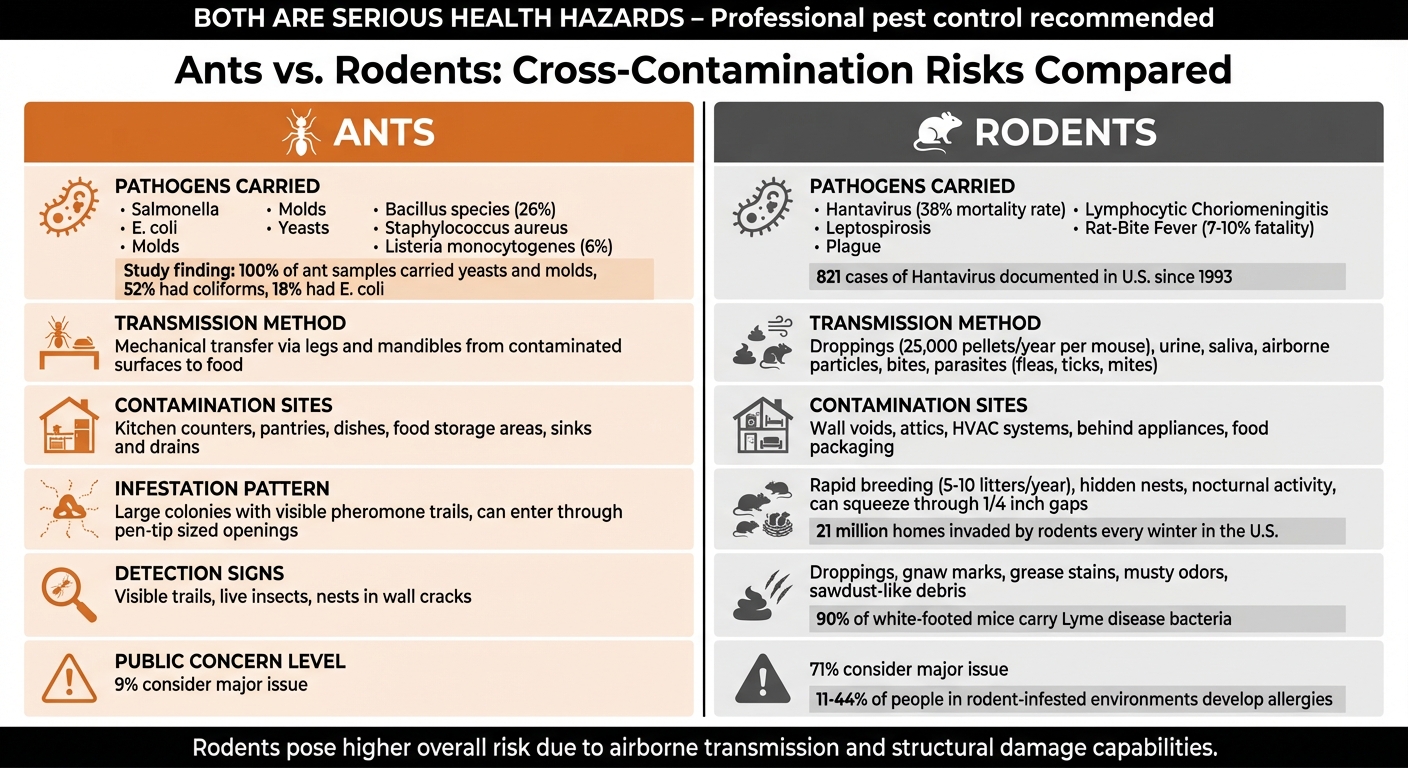
Ants vs Rodents Health Risks and Contamination Comparison Chart
Cross-Contamination Risks from Ants
Pathogens Carried by Ants
Ants can act as unintentional transporters of harmful pathogens, moving bacteria, fungi, and even fecal contaminants from dirty areas to clean surfaces. After crawling through places like soil, trash bins, drains, or pet waste zones, these tiny insects can carry contaminants on their legs and mandibles. The result? They transfer these pathogens onto cutting boards, dishes, and sometimes directly onto food .
A study conducted between September and October 2016 by Leckranee Simothy and Hudaa Neetoo at the University of Mauritius examined ant infestations in five kitchens in the Pamplemousses district. Their findings were eye-opening: every single ant sample tested carried yeasts and molds; 52% were positive for coliforms; 18% contained E. coli; 8% carried Salmonella; and 6% tested positive for Listeria monocytogenes.
"Since ants have the ability to harbor and subsequently transfer pathogenic or toxigenic microorganisms, ants may act as disease vectors and contaminate food, water and food-contact surfaces of kitchens resulting in foodborne illnesses." – AIMS Microbiology
Additionally, ants were found to carry Bacillus species (26% of samples), Staphylococcus aureus, Shigella, Klebsiella pneumoniae, and Serratia. Notably, Serratia is linked to about 2% of bloodstream infections . Living in dense colonies, ants can spread these germs among themselves, amplifying the risk of contamination as they move through homes. The study highlights the direct connection between the pathogens ants carry and the contamination found in kitchens, emphasizing the practical dangers they pose in everyday household environments.
Where Ants Cause Contamination
Ants’ ability to carry and deposit pathogens makes them a serious threat to household hygiene, especially in kitchens and pantries. Drawn to sugars, starches, and proteins, they often invade foods like cereals, baked goods, and anything stored in open or poorly sealed containers . They can even chew through non-airtight packaging to access dry goods, spreading contaminants in the process.
Sinks and drains are also hotspots for contamination. These areas provide the moisture and organic residue that ants thrive on, often leading them to pick up Bacillus species. Food storage areas like bread boxes and cupboards are equally at risk when ants crawl across surfaces or penetrate weak packaging, leaving behind coliforms and other harmful pathogens . Some species, such as pharaoh ants, can even nest within walls, allowing them to move freely throughout an entire building and spread contamination on a larger scale.
sbb-itb-be66415
Cross-Contamination Risks from Rodents
Diseases Spread by Rodents
Rodents are known carriers of over 35 diseases, which they spread through both direct and indirect contact. Direct transmission occurs via handling, bites, scratches, or inhaling dust contaminated by their droppings or urine. Indirect transmission involves fleas, ticks, or mites that have fed on infected rodents and then bite humans.
One of the most dangerous diseases they spread is Hantavirus Pulmonary Syndrome (HPS), which has a mortality rate of 38%. Deer mice are the primary carriers, and the disease is often contracted by inhaling airborne particles from disturbed droppings or urine. By 2021, the CDC had documented 821 cases of HPS in the U.S. since 1993. Another serious illness is Lymphocytic Choriomeningitis (LCM), carried by house mice. This disease can cause meningitis and encephalitis and poses severe risks during pregnancy, including potential birth defects or fetal death.
Other rodent-borne diseases include:
- Leptospirosis: A bacterial infection from consuming food or water contaminated with rodent urine, which can lead to kidney or liver failure.
- Plague: Caused by Yersinia pestis, it spreads through infected flea bites and can result in swollen lymph nodes and septic shock.
- Rat-Bite Fever: Transmitted through bites, scratches, or contact with dead rodents, this disease has a fatality rate of 7–10% if untreated.
| Disease | Primary Carrier | Transmission Route | Key Health Risk |
|---|---|---|---|
| Hantavirus (HPS) | Deer Mouse, Rice Rat | Inhalation of contaminated dust | Respiratory failure; 38% mortality |
| LCM | House Mouse | Contact with urine/saliva/droppings | Meningitis; birth defects |
| Leptospirosis | Various Rats/Mice | Contaminated food/water/urine | Kidney or liver failure |
| Plague | Rats, Rock Squirrels | Infected flea bites | Swollen lymph nodes; septic shock |
| Rat-Bite Fever | Rats | Bites, scratches, or waste contact | Fever, joint pain; 7–10% fatality |
These health risks are exacerbated by the contamination rodents leave behind in the spaces they inhabit.
How Rodents Contaminate Spaces
Rodents are relentless in their contamination of indoor environments, leaving behind droppings, urine, and saliva. A single mouse can produce up to 25,000 fecal pellets in a year, defecating around 70 times daily. This constant contamination heightens food safety risks, as tainted food or water can lead to illnesses like salmonellosis or leptospirosis.
Rodents also cause physical damage that increases the likelihood of contamination. By gnawing through food packaging, storage materials, and even structural components, they create new entry points and spread pathogens. Mice can squeeze through openings as small as 1/4 inch – roughly the size of a nickel. They often nest in hidden areas like attics, crawlspaces, or HVAC systems, where their waste and nesting materials can contaminate air circulated throughout a building.
"The National Pest Management Association estimates that rodents invade about 21 million homes in the United States every winter, squeezing through spaces as small as a nickel." – PestWorld
Disturbing dried droppings, urine, or nesting materials can release pathogens like hantavirus into the air. To clean rodent waste safely, ventilate the area for at least 30 minutes, then soak the waste in a 10% bleach solution (1 part bleach to 9 parts water) for 5–10 minutes before wiping it up. Sweeping or vacuuming rodent droppings should be avoided to prevent airborne transmission of harmful pathogens.
Allergens and Parasites from Rodents
Rodents don’t just spread diseases – they also introduce allergens and parasites into the environments they infest. Proteins in their dander, urine, droppings, and saliva can trigger allergic reactions. Studies show that 11% to 44% of individuals working in rodent-infested environments develop allergies, and 5% to 10% may develop asthma. For those with pre-existing asthma, exposure to these allergens can worsen symptoms and lead to more frequent attacks, further degrading indoor air quality.
Rodents also carry parasites like fleas, ticks, and mites, which can transmit additional diseases. For example:
- Fleas can spread plague.
- Ticks may carry Lyme disease and tularemia.
- Mites can transmit scrub typhus.
Notably, around 90% of white-footed mice are carriers of the bacterium that causes Lyme disease. Pregnant women and immunocompromised individuals face particular risks from Lymphocytic Choriomeningitis Virus (LCMV), which is carried by about 5% of house mice.
Ants vs. Rodents: Side-by-Side Comparison
Pathogen Types and How They Spread
Ants and rodents contaminate in very different ways. Ants act as “mechanical transporters,” carrying bacteria, yeasts, and molds on their legs and mandibles as they forage. When they crawl over clean dishes, cutting boards, or uncovered food, they leave these pathogens behind.
"Since ants have the ability to harbor and subsequently transfer pathogenic or toxigenic microorganisms, ants may act as disease vectors and contaminate food, water and food-contact surfaces." – Leckranee Simothy et al., University of Mauritius
Rodents, on the other hand, spread disease through a variety of methods. Their urine, feces, and dried waste can contaminate surfaces, food, and even the air. They also transmit diseases directly through bites and scratches, or indirectly via parasites like fleas and ticks. According to Frank Meek, BCE, PHE, PCQI, rodents and their parasites can carry over 35 different illnesses.
| Feature | Ants | Rodents |
|---|---|---|
| Primary Pathogen Types | Bacteria (E. coli, Salmonella), Yeasts, Molds | Viruses (Hantavirus), Bacteria (Leptospirosis, Plague), Parasites |
| Transmission Mode | Mechanical transfer via legs and mandibles during foraging | Excretions (urine, feces, saliva), bites, and airborne particles |
| Primary Contamination Sites | Kitchen counters, dishes, pantries, and other food-contact surfaces | Wall voids, behind appliances, food packaging, and the air |
| Secondary Risks | Aesthetic nuisance and food spoilage | Structural damage, allergens, and fire hazards from chewed wires |
Next, let’s look at how their behaviors shape infestation patterns and contamination risks.
Infestation Patterns and Risk Levels
The way ants and rodents infest spaces has a direct impact on contamination risks. Ants form large colonies, with workers following pheromone trails to food sources. Their tiny size allows them to sneak through cracks and even access sealed containers, leading to widespread surface contamination. However, only 9% of people consider ants a major issue, compared to 71% who are concerned about rodents.
Rodents reproduce at an alarming rate – producing 5 to 10 litters annually – and hide their nests in areas like wall voids, attics, and behind appliances. Their nocturnal habits allow contamination to build up unnoticed in concentrated areas. This rapid reproduction and hidden nesting make rodent infestations particularly dangerous for cross-contamination.
| Feature | Ants | Rodents |
|---|---|---|
| Infestation Pattern | Large colonies with pheromone-led foraging trails | Rapid breeding (5–10 litters/year) and nocturnal nesting in hidden areas |
| Contamination Severity | Moderate to high due to frequent surface contact | Very high because of airborne transmission and structural damage |
| Detection Signs | Visible trails, live insects, and nests in wall cracks | Droppings, gnaw marks, grease stains, and musty odors |
| Risk Circumstances | Higher in kitchens with exposed food and poor sanitation | Higher in areas with structural gaps and accessible nesting materials |
These distinctions highlight the importance of tailored prevention strategies for each pest type.
The public health impact of rodents
How to Prevent Ant and Rodent Infestations
Ants and rodents might both be drawn to food, water, and shelter, but they approach infestations in very different ways. Because of this, keeping them out requires distinct strategies tailored to their behaviors and vulnerabilities.
Preventing Ant Infestations
Ants are tiny and resourceful, able to slip through openings as small as the tip of a pen. Start by sealing any cracks around windows, doors, and utility pipes using silicone caulk. Check the weatherstripping on exterior doors – if you can see daylight through it, ants can likely get in.
"A single scout ant that finds food can lay down a pheromone trail, leading hundreds of its nestmates right to the source. By eliminating even the tiniest crumbs, you break that chemical chain of communication." – West Pest Co.
To disrupt these pheromone trails, clean countertops daily with a mix of white vinegar and water. Store pantry items like sugar, flour, and cereal in airtight containers to block access, and rinse recyclables to remove sugary residues. Research from 2018 revealed that 84% of people identified food availability as the main reason ants invade homes.
Outdoor maintenance is just as important. Keep vegetation trimmed at least one foot away from your home, as recommended by 82% of pest control experts. Creating an 18- to 24-inch gravel or stone barrier around your foundation can help keep the area dry and less appealing to ants. Address any moisture issues, like leaky faucets, to deter water-seeking species such as carpenter ants. If you notice sawdust-like piles (called frass), it could signal structural damage caused by carpenter ants, and it’s best to contact a Bellingham pest control expert.
Rodent prevention, on the other hand, focuses more on physical barriers and waste management.
Preventing Rodent Infestations
Unlike ants, rodents require sturdier exclusion methods because they can chew through weaker materials like spray foam or thin plastic. Mice can squeeze through gaps as small as 1/4 inch, while rats can fit through holes the size of a quarter. To block these entry points, fill small gaps with steel wool or copper mesh and seal them with silicone or polyurethane caulk. For larger openings or vents, use 1/4-inch galvanized hardware cloth.
Proper food and waste storage is critical. Keep pantry staples and pet food in durable, airtight containers. To reduce nesting opportunities, store firewood, lumber, or hay at least 12 inches off the ground and 20 feet away from your home. Use heavy-duty garbage cans with locking lids and clean recycling bins regularly to avoid attracting rodents.
Trapping is another useful tactic. Place snap traps in a "T" formation along walls and baseboards – areas where rodents naturally travel. Unlike ant baits, indoor rodent baits are often discouraged because rodents may die in hidden spaces, leading to decomposition issues inside walls.
When cleaning up after rodents, safety is key. Spray droppings with a 10% bleach solution and ventilate the area before cleaning. Avoid vacuuming or sweeping rodent waste, as this can spread harmful particles into the air.
Professional Pest Control with Sparrow’s Pest Control
Even the best prevention methods can sometimes fail to keep pests at bay. When infestations persist, it’s time to call in the experts. Sparrow’s Pest Control has been serving Bellingham, WA, and surrounding areas for over 30 years, tackling the region’s unique pest problems. From moisture-loving carpenter ants to rodents drawn to waterfront properties, they’ve seen it all and know how to handle it effectively.
Sparrow’s approach to rodent control starts with sealing entry points using durable, industry-grade sealants and steel mesh. This ensures rodents can’t re-enter, whether through the foundation or the roofline. Inside the home, they rely on targeted trapping rather than hazardous poisons, keeping families and pets safe from chemical exposure.
"The constant rain keeps rodents seeking warm, dry shelter. No amount of trapping will ever solve the problem if they can continue to get inside." – Sparrow’s Pest Control
For ant infestations, Sparrow’s uses perimeter treatments around the home and targeted extermination to keep pests out of food areas. Seasonal treatments for carpenter ants are particularly important, as local colonies can grow to a staggering 15,000 ants with multiple satellite nests. Their services adhere to Integrated Pest Management (IPM) principles, which address environmental factors like food sources and shelter to reduce the risk of cross-contamination.
Service Plans for Every Household
Sparrow’s Pest Control offers three service plans tailored for homes up to 2,500 sq ft. Each plan focuses on reducing contamination risks and addressing specific pest challenges:
- Basic Plan ($39/month): Includes quarterly perimeter sprays to keep nuisance insects at bay and prevent surface contamination.
- Essential Plan ($45/month): Adds rodent bait stations, de-webbing, wasp prevention, and seasonal carpenter ant treatments to tackle pests that carry pathogens.
- Premium Plan ($59/month): Covers everything in the Essential Plan plus active wasp nest removal, flea and tick treatments, roach protection, and full rodent exclusions to eliminate disease vectors.
All plans come with free re-treatments between scheduled visits if pests return, and every service is backed by a 100% satisfaction guarantee.
Integrated Pest Management (IPM) in Action
Sparrow’s IPM strategy goes beyond just treating infestations – it addresses the root causes while minimizing the spread of pathogens. Their three-pronged approach includes:
- Cultural control: Eliminating food sources and shelter that attract pests.
- Mechanical control: Using physical barriers and traps to prevent contamination without relying on chemicals.
- Chemical control: Applying EPA-approved products only when absolutely necessary to ensure safety and effectiveness.
"Our approach to extermination prioritizes the safety of your family and pets. We use the most advanced, EPA-approved products and Integrated Pest Management (IPM) strategies." – Sparrow’s Pest Control
The process starts with a detailed inspection to locate nesting sites and entry points. From there, Sparrow’s develops a customized treatment plan and offers follow-up prevention advice. This comprehensive approach not only resolves the immediate problem but also helps protect your home from future infestations.
Conclusion
Ants and rodents pose distinct health risks. Ants can spread bacteria like Salmonella and E. coli through direct contact, while rodents transmit dangerous pathogens like Hantavirus via contaminated droppings.
Because of these differences, cleanup methods should be tailored. For rodent waste, use a mask and a 10% bleach solution to sanitize safely. Meanwhile, ant trails can be addressed with standard disinfectants.
Both pests can escalate into serious problems quickly. Rodents reproduce at an alarming rate – producing 5 to 10 litters per year – and can squeeze through openings as small as 1/4 inch. Ants, on the other hand, are incredibly strong for their size, capable of carrying 50 times their weight, which makes them efficient at contaminating food supplies.
To prevent infestations, focus on sealing entry points, keeping food in airtight containers, and eliminating attractants. Since DIY pest control methods fail about 90% of the time, professional assistance often becomes necessary.
If an infestation gets out of hand, calling in experts is the best course of action. Sparrow’s Pest Control provides thorough solutions starting at $39/month. Their methods are safe for families and pets, and they back their services with a 100% satisfaction guarantee. Take action now to safeguard your home from health risks, food contamination, and structural damage.
FAQs
Which is riskier for my family: ants or rodents?
Rodents can be a serious threat to your family’s health. They are known to spread harmful bacteria, viruses, and diseases such as salmonella, hantavirus, and leptospirosis. Ants, on the other hand, typically contaminate food and surfaces with bacteria like Salmonella and E. coli. While the bacteria ants carry may not seem as dangerous at first, they still pose a risk that shouldn’t be ignored. Taking quick action to deal with infestations is essential to safeguard your household from these potential health hazards.
Do I need to throw out food if I see ants or rodent droppings?
If you spot ants or rodent droppings near your food, it’s time to throw it out. These pests can carry harmful bacteria and pathogens, making the food unsafe to eat. Disposing of contaminated food right away not only protects your health but also helps prevent future pest problems.
When should I call Sparrow’s Pest Control instead of DIY?
If you’re spotting signs of a serious pest problem – like rodent droppings, gnaw marks, or potential entry points that require expert care – reach out to Sparrow’s Pest Control. They offer thorough inspections, customized treatment plans, and preventive strategies to address the issue effectively and keep pests away for good. If your DIY efforts haven’t done the trick or you’re unsure how bad the situation is, their family- and pet-friendly solutions come with a satisfaction guarantee, giving you confidence and peace of mind.