
In Washington State, disposing of pesticides in drains or trash is illegal due to risks to water, wildlife, and public health. The Washington State Department of Agriculture (WSDA) provides a free pesticide disposal program to safely handle waste. Key rules include:
- Limits: 750 lbs per person and 10,000 lbs per event for 2026–2027.
- Priority Waste: High-risk pesticides like "Danger Poison" or damaged containers.
- Exclusions: Household waste, fertilizers, motor oils, and non-rinsed containers.
- Process: Submit an inventory form at least a month before events, follow proper packaging, and attend scheduled collection dates.
Upcoming events include Othello (March 26), Puyallup (April 16), and Spokane (April 23). Proper storage, triple-rinsing, and using alternatives like local hazardous waste facilities or professional pest control services can simplify compliance and reduce waste.
Washington State’s Pesticide Waste Disposal Rules
WSDA Waste Pesticide Program Overview
The Washington State Department of Agriculture (WSDA) runs a free pesticide collection program designed to help residents, farmers, small businesses, and public agencies safely remove unusable agricultural and commercial-grade pesticides from the waste stream.
For the 2026–2027 period, the program has specific limits: each customer can dispose of up to 750 lbs per event, with a total event capacity capped at 10,000 lbs. Planning ahead is crucial since any waste exceeding these limits will not be accepted.
The program focuses on high-risk pesticides, such as those labeled "Danger Poison" or "Peligro Veneno", products marked "Danger", chemicals in damaged or unlabeled containers, and pesticides stored in old glass containers. Low-priority items include adjuvants unless they have extreme pH levels.
Certain items are not accepted, including household hazardous waste, fertilizers, motor oils, paint, solvents, and non-rinsed empty containers. To properly dispose of empty containers, ensure they are triple-rinsed before recycling or discarding them as solid waste.
Key Compliance Deadlines and Processes
Following the program’s rules requires careful attention to deadlines and documentation.
Start by downloading and completing the Customer Inventory form. Submit the form via email to Wastepesticide@agr.wa.gov or mail it to the WSDA Pesticide Disposal Program in Olympia. To ensure your spot, send your form at least one month before the collection week – even if the event hasn’t been officially announced yet.
Once your application is processed, you’ll receive an appointment, a site map, and a bill-of-lading. At the event, you’ll need to sign the "Declaration of Waste Pesticide" to officially transfer ownership of the waste to the WSDA. Keep both the signed declaration and the bill-of-lading as permanent records of proper disposal.
Upcoming collection events are scheduled as follows:
- Othello: March 26
- Puyallup: April 16
- Spokane Region: April 23
- Yakima Region: April 29
- Okanogan: May 12
Additionally, facilities must submit their annual RCRA hazardous waste report by March 1 to remain compliant with state regulations.
sbb-itb-be66415
Chemsweep: What to do with unwanted pesticides
Common Compliance Challenges
Navigating the regulatory framework discussed earlier is crucial because each compliance challenge – whether it’s waste classification, container condition, or weight limits – requires careful attention to meet Washington’s rules.
Waste Classification Problems
Properly identifying pesticide waste under Washington’s designation system can be tricky. One common mistake is mixing waste streams by including household hazardous waste, which the WSDA program does not accept.
Businesses also struggle with state-specific criteria. If a waste doesn’t qualify as federally listed or characteristic waste, it must be evaluated through Steps 5 through 7 of Washington’s designation process.
The toxicity calculation adds another layer of complexity. When using the "book designation" method, you must select the highest toxicity value from available test results – such as fish, oral rat, inhalation rat, or dermal rabbit. Picking the wrong value could reclassify waste from WT02 (220 lb monthly limit) to WT01 (2.2 lb limit), which significantly tightens disposal requirements.
Another common oversight involves summing the concentration percentages of Halogenated Organic Compounds (HOC) or Polycyclic Aromatic Hydrocarbons (PAH). Missing this step can lead to misclassification under WP01, WP02, or WP03 criteria and improper disposal of persistent chemicals.
Now, let’s look at the challenges tied to container integrity, which can further complicate compliance.
Damaged or Non-Original Containers
Pesticides stored in damaged or unstable containers pose a significant risk. Under WAC 173-303-630, these must be managed immediately to avoid spills or vapor releases. The situation becomes more complicated when labels are missing or unreadable. In such cases, the WSDA must test these "unknowns" to determine their pH levels before accepting them for disposal.
Despite these challenges, the WSDA prioritizes damaged or non-original containers during collection events. High-priority items include products in poor condition, old glass containers, and those without original packaging. If you have more than ten containers of unknown contents or any containers larger than 5 gallons with unidentified ingredients, the WSDA offers free on-site technical assistance to help inventory and over-pack these items safely.
Containers must also meet labeling requirements. They should display the words "Dangerous Waste" or "Hazardous Waste" along with descriptive words or pictograms indicating specific hazards like toxicity, corrosiveness, or flammability. For containers larger than one gallon, the lettering must be legible from 25 feet away or at least one-half inch tall.
After addressing container issues, it’s important to consider the challenges related to weight and quantity limits.
Weight and Quantity Limit Issues
Strict weight and quantity limits can complicate pesticide disposal. For instance, the WSDA enforces a 750 lb per customer limit and a 10,000 lb total event capacity. Once either limit is reached, no additional waste is accepted, regardless of its hazard level.
Businesses using Satellite Accumulation Areas (SAAs) face even tighter rules. If you exceed 2.2 lbs of acutely hazardous waste or 55 gallons of total waste, you must transfer it to a centralized area within three days. Local disposal facilities add further restrictions—while Bellingham pest control experts can advise on local nuances, King County sites, for example, cap liquid waste at 5 gallons or one case per visit unless special arrangements are made.
To avoid exceeding these limits, focus on disposing of pesticides with "Danger/Poison" signal words or those in leaking containers first, as these are the WSDA’s top priority. Additionally, you can reduce disposal burdens by working with suppliers to return unused experimental or seasonal pesticides through written agreements.
How to Dispose of Pesticide Waste Properly
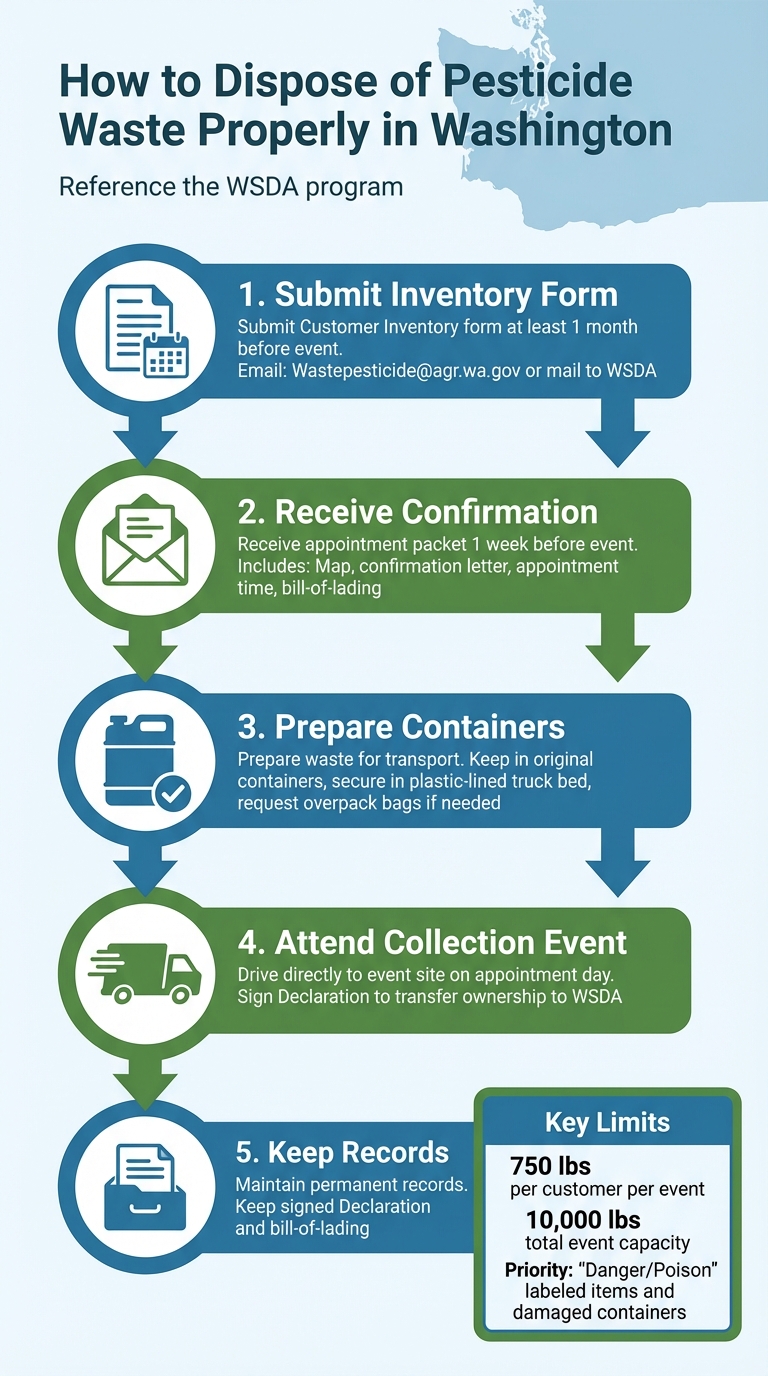
Washington State Pesticide Disposal Process: 5 Steps to Compliance
After identifying your compliance challenges, follow these specific steps to ensure proper pesticide waste disposal. These steps align with WSDA protocols mentioned earlier.
Preparing for Collection Events
Start by submitting a Customer Inventory form at least one month before your chosen collection event. You can download the form from the WSDA website and either email it to Wastepesticide@agr.wa.gov or send it by mail. Once your inventory is reviewed, WSDA staff will contact you to confirm your reservation. About a week before the event, you’ll receive a packet containing a map, a confirmation letter with your appointment time, and a bill-of-lading.
If you need overpack bags for damaged containers, request them in advance. On the event day, sign the Declaration to transfer ownership of the waste to WSDA. Ensure that pesticides are transported in their original containers, secured in a plastic-lined truck bed, and drive directly to the event site.
Container Rinsing and Storage
Properly rinsing containers is key to reducing residual hazards and allows the clean, dry plastic to be discarded as solid waste instead of hazardous waste. The triple-rinsing method works as follows:
- Empty the container into your spray tank and let it drain for 30 seconds.
- Add water until the container is about one-quarter full, recap, and shake for 30 seconds. Then drain it again.
- Repeat this process two more times.
For a faster clean, you can use pressure rinsing. With a water source delivering at least 40 psi, hold the container over your spray tank, puncture the lower side with a pressure nozzle, and rinse for at least 30 seconds. Rotate the nozzle to ensure all internal surfaces are thoroughly rinsed. Once clean, store the rinsed containers and caps until they can be recycled or properly disposed of.
Using Local Disposal Resources
If your waste isn’t eligible for WSDA collection, consider local disposal options to remain compliant.
Partially filled household pesticide containers should not be taken to WSDA collection events. Instead, contact your local solid waste agency or call 1‑800‑CLEANUP for guidance. According to Seattle Public Utilities:
disposal down the drain or in the trash is illegal in Washington State, despite instructions on most product labels.
Businesses in King County classified as Small Quantity Generators – those producing less than 220 lbs (about 25 gallons) of hazardous waste per month – can use Household Hazardous Waste facilities for up to four no-cost visits per year. Before visiting, call the Business Waste Line to confirm eligibility. For items not accepted by WSDA, such as fertilizers, motor oils, paint, or solvents, your county solid waste program can direct you to the correct facility.
Reducing Pesticide Waste Through Better Practices
The best way to tackle pesticide waste is to stop it from being created in the first place. By using smart storage and application techniques, you can cut down on the amount of unusable product that ends up needing disposal. These methods not only reduce waste but also make it easier to comply with WSDA regulations.
WAC 16-228 Storage Requirements
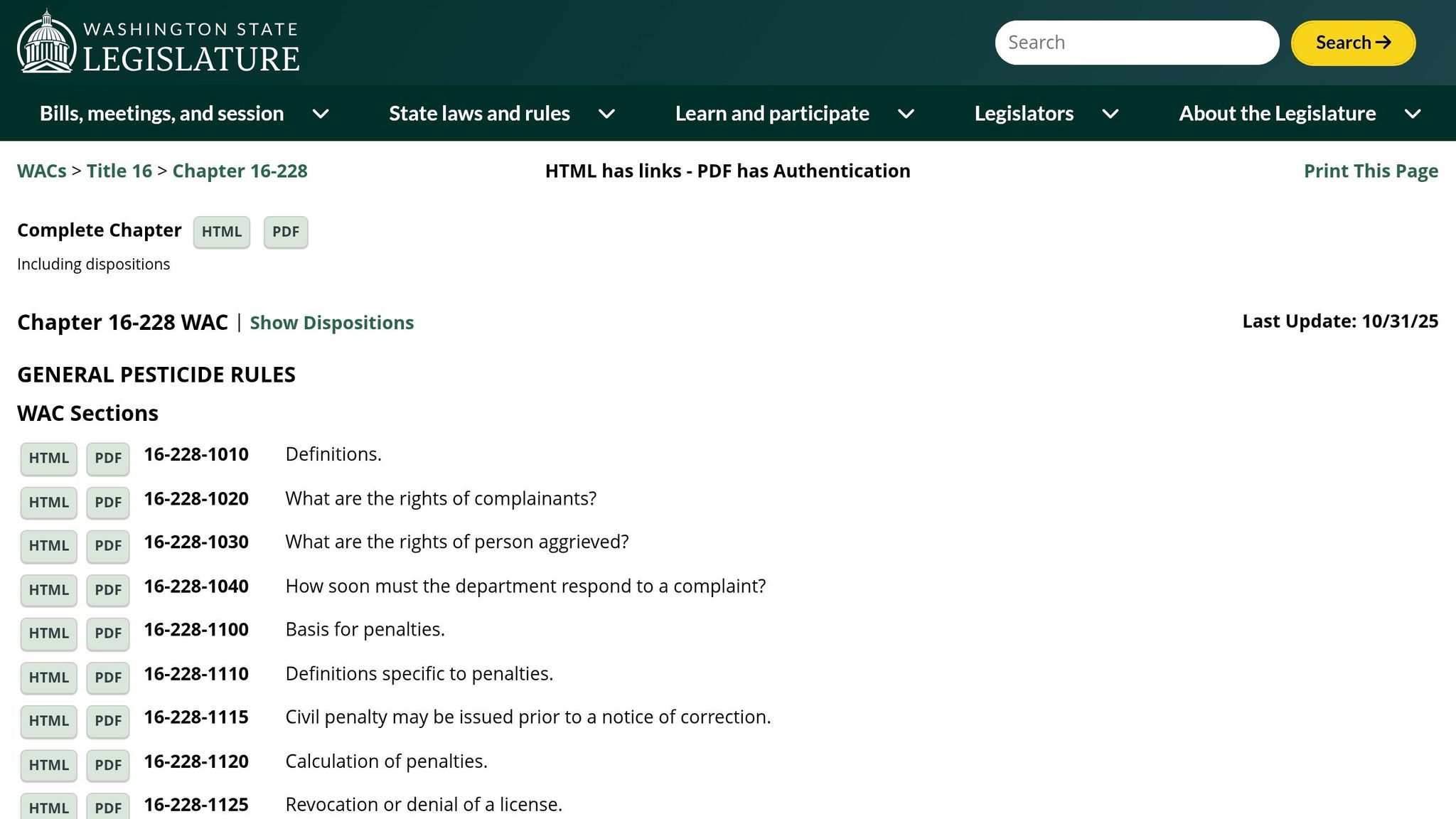
Washington’s WAC 16-228 rules are all about preventing container damage and keeping the environment safe. Pesticides should always be stored in their original, intact, and labeled containers. If a container is damaged or leaking, it needs to be removed right away.
The storage requirements vary based on the product’s signal word. For example, pesticides labeled "Danger/Poison" must be stored in a locked area with clear warning signs displayed. For bulk storage (50 gallons or more), secure closures like screw-type bungs or locked valves are required. Facilities handling bulk pesticides must also have secondary containment systems that match the container size.
To avoid contamination, pesticides should never be stored near food, animal feed, drugs, or clothing. Regular inventory checks are a good idea to spot and address damaged containers early, preventing waste from piling up.
Integrated Pest Management (IPM) Approaches
Integrated Pest Management (IPM) is all about stopping pest problems before they start instead of just reacting to them. One simple step is buying only what you need for the current season and mixing just enough pesticide for each application to avoid leftovers.
Timing is also key. Applications should be scheduled to avoid periods when plants are blooming or when corn is shedding pollen, which helps protect pollinators. It’s also important to consider each pesticide’s toxicity, volatility, and mobility to reduce risks like water pollution and harm to non-target species.
Weather matters too – avoid spraying during conditions that could cause pesticides to drift or evaporate, which could damage nearby property, harm wildlife, or even pose risks to people. Using backflow prevention devices during mixing and loading is another critical step to keep pesticides from contaminating water supplies.
For rodenticides, any spilled bait should be cleaned up immediately, and all bait must be collected after the operation is finished. These practices not only cut down on waste but also align with Washington’s environmental standards, making proper disposal easier and more effective.
Conclusion
Washington’s pesticide waste rules are easier to follow once you get the basics down. The WSDA Waste Pesticide Program provides free collection and disposal services for agricultural and commercial-grade pesticides. Events are planned through 2026, with upcoming dates in Othello (March 26), Puyallup (April 16), and Spokane (April 23). Keep in mind that there are set limits for disposal, so planning ahead is key.
To comply with the program, submit your forms at least one month before the event and make sure your containers are prepared correctly. This step ensures smooth processing and avoids potential issues. If you’re dealing with damaged containers or pesticides labeled "Danger/Poison", the WSDA offers free over-pack bags and technical support. For household-grade pesticides, your local Household Hazardous Waste facility is the right place to turn.
You can avoid creating waste by storing pesticides in their original, secure containers and only purchasing what you need. Follow WAC 16-228 guidelines for keeping high-risk items locked away. Triple-rinse empty containers right away to make them ready for recycling through programs like Agri-Plas, Inc.. These small but important steps help you stay compliant while protecting the environment.
FAQs
How do I know if my pesticide waste qualifies for the WSDA program?
To determine if your pesticide waste meets the requirements for the WSDA Waste Pesticide Program, start by reviewing their specific criteria. Factors like the chemical makeup of the waste, its prior use, and how it’s currently being disposed of will influence eligibility. For complete details and guidance, check out the resources provided by the Washington State Department of Agriculture.
What should I do if a pesticide container is leaking or missing a label?
If you notice a pesticide container leaking or missing its label, act quickly. Transfer the pesticide to a secure, intact container, ensuring it’s properly sealed. Always handle leaks or spills right away, following your state’s specific guidelines for disposal and labeling. This ensures safety and compliance with regulations.
What are my options if I miss an event or my waste exceeds the limit?
If you miss a pesticide disposal event or have more than the 10,000-pound weight limit, reach out to your local hazardous waste facility or solid waste agency for advice. Many household hazardous waste facilities can also accept pesticides from residents and small businesses. Disposing of pesticides correctly is crucial to avoid harm to the environment and to stay compliant with regulations. Be sure to follow local rules when managing excess pesticide waste.