The Pacific Northwest’s climate supports year-round livestock pests, which harm animals and reduce farm productivity. These pests affect livestock directly (flies, lice, ticks, mites) and indirectly (soil pests like slugs and wireworms damaging pastures). Key pest zones exist: west of the Cascades, including Bellingham pest control service areas (wet conditions favor slugs, crane flies) and east of the Cascades (dry climate supports grasshoppers, mites). Effective pest management hinges on understanding pest biology and using Integrated Pest Management (IPM).
Quick Facts:
- Horn Flies: Blood-feeding pests causing weight loss and milk production decline. Manage with insecticide ear tags and feed-through IGRs.
- Stable Flies: Painful biters targeting cattle legs. Control with cleanliness and permethrin treatments.
- Cattle Lice: Thrive in winter, causing anemia and reduced productivity. Treat with pour-ons and ivermectin.
- Cattle Grubs: Internal parasites causing hide damage and stress. Use systemic insecticides post-fly season.
- Spinose Ear Ticks: Infest ears, causing irritation and infections. Use ear dusts or sprays.
- Scabies Mites: Burrow into skin, causing severe itching and productivity loss. Treat with eprinomectin or ivermectin.
- Ticks: Blood loss and anemia from species like Pacific Tick or Winter Tick. Use insecticide ear tags and sprays.
Early detection and regular monitoring are critical. Effective pest control minimizes economic losses while supporting livestock health.
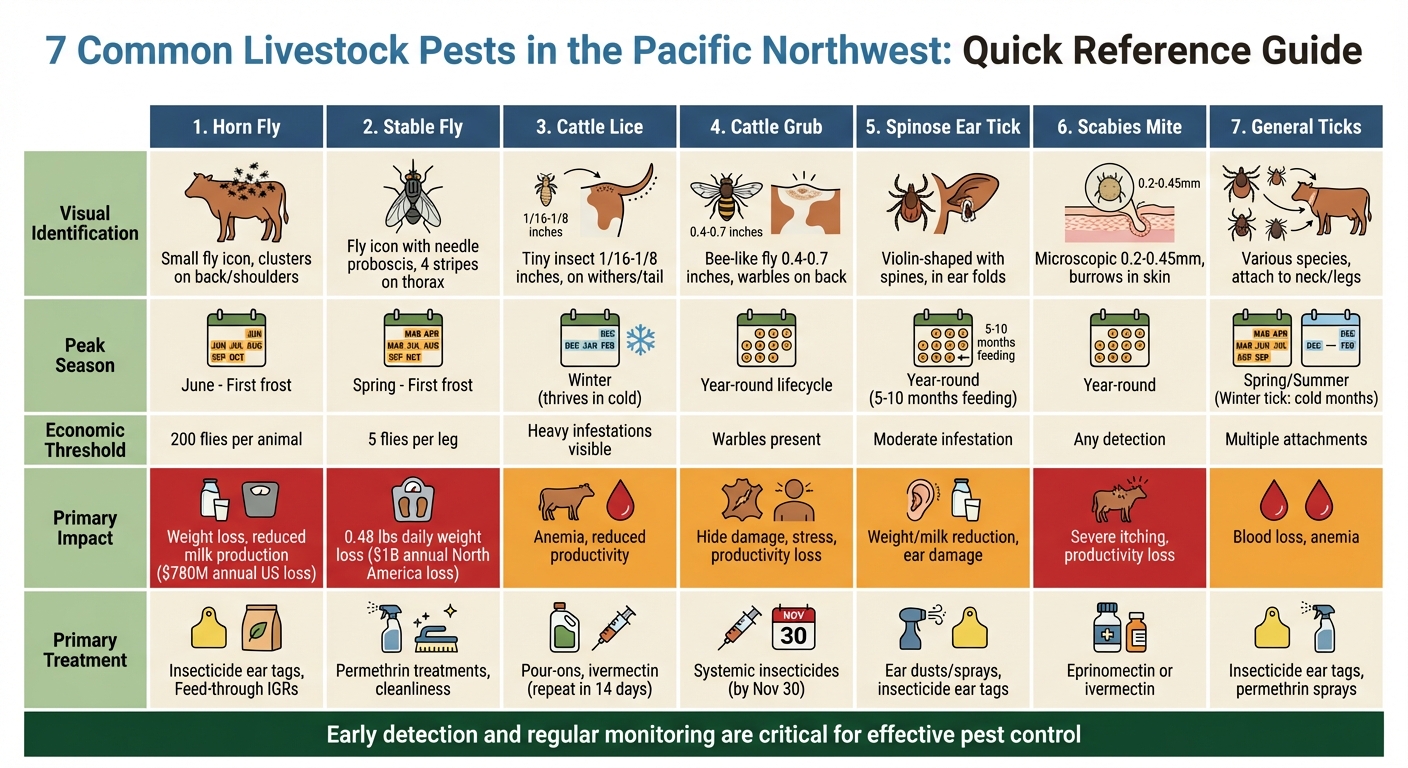
7 Common Livestock Pests in Pacific Northwest: Identification and Treatment Guide
1. Horn Fly
Identification Characteristics
Horn flies (Haematobia irritans) are small, blood-feeding pests that target cattle. Both males and females rely on blood meals, clustering on the animals’ backs, sides, and shoulders. During hotter parts of the day, they often shift to the belly for relief from the heat.
What sets horn flies apart from other livestock pests is their specific feeding and breeding habits. Unlike stable flies, which prefer feeding on the lower body and legs, horn flies stick to the upper body. Face flies, on the other hand, don’t bite at all; they use their rasp-like mouthparts to feed on tear secretions near the eyes. When it comes to breeding, horn flies only lay eggs in fresh cattle manure, whereas stable flies require decaying organic matter like old manure or silage.
Seasonal Activity and Lifecycle
Horn flies in the Pacific Northwest typically emerge by June, though they may appear earlier. They remain active until the first hard frost in the fall. Their life cycle is remarkably fast, taking just 10 to 20 days in warm weather. Female horn flies can lay up to 500 eggs in fresh cattle manure, where larvae develop and pupae overwinter. This rapid reproduction allows for several generations each year, leading to infestations that can severely affect livestock health.
Livestock Impact
Horn flies cause considerable harm to livestock through their relentless blood-feeding behavior. Each fly can bite an animal 20 to 30 times daily. When their numbers exceed 200 flies per animal – the economic threshold – cattle often exhibit "bunching" behavior, attempting to escape the irritation.
Severe infestations disrupt normal grazing and feeding habits, reducing weight gain and milk production. These losses, combined with control measures, cost the U.S. livestock industry over $780 million annually. Larger animals like cows, steers, and bulls are the primary targets, with calves generally unaffected until late summer. Early detection and effective control strategies are crucial to minimizing these impacts.
Management and Prevention Methods
Managing horn flies effectively is crucial to protecting livestock. One approach involves using insecticide ear tags in the spring. To prevent resistance, alternate annually between organophosphate and pyrethrin-based tags, and remove them in the fall.
Feed-through insect growth regulators (IGRs), such as methoprene or diflubenzuron, can be added to feed or mineral blocks. Start using these 30 days before fly season and continue until the first hard frost to disrupt larval development. Pour-on insecticides offer immediate relief but need to be reapplied every two weeks. Another practical method is dragging pastures to break up fresh manure pats, helping to dry them out and kill larvae.
sbb-itb-be66415
2. Stable Fly
Identification Characteristics
Stable flies (Stomoxys calcitrans) are often mistaken for house flies due to their similar size, but they have some telltale features. Most notably, they have a sharp, needle-like proboscis that sticks out from their head, even when they’re resting, and delivers painful bites. Their thorax has four stripes, with the outer two appearing broken, and their abdomen displays a checkered or spotted pattern. When resting, their wings are held wide at the tips, and during feeding, they position their head and proboscis upward.
Seasonal Activity and Lifecycle
Stable flies thrive during warmer months, completing their lifecycle in about 21 days. This quick cycle allows them to produce several generations between spring and the first hard frost in the fall. A single female can lay between 200 and 400 eggs, typically in moist, organic materials like soiled straw, calf bedding, silage, or decaying feed. Adults, which live 20–30 days, feed on blood regardless of sex. These flies are also known for their ability to travel long distances, often moving far from their breeding grounds in search of new hosts. Their rapid reproduction and mobility make them a persistent issue for livestock.
Livestock Impact
Stable flies primarily attack the lower legs and belly of cattle. Just five flies per leg are enough to significantly affect cattle, reducing daily weight gain by around 0.48 pounds. Their painful bites force animals to bunch together and stomp their legs repeatedly, cutting into time spent grazing and drinking. These behaviors contribute to substantial economic losses – nearly $1 billion annually for livestock producers in North America. Addressing these impacts requires focused prevention and control strategies.
Management and Prevention Methods
The first step in managing stable flies is maintaining cleanliness. Regularly removing soiled bedding, manure, and spilled feed – especially around calf hutches and feed bunks – helps disrupt their breeding cycle. To prevent larvae from developing in manure, supplements containing diflubenzuron or tetrachlorvinphos can be introduced in early spring and continued until colder weather arrives. For direct control on animals, permethrin or zeta-cypermethrin ear tags applied in spring can be effective. Sprays or dusts should target the legs and lower body, where these flies typically feed. Additionally, backrubbers treated with permethrin can be placed in areas where livestock tend to gather, providing another layer of protection.
3. Cattle Lice
Identification Characteristics
Lice infestations are another challenge cattle face, alongside flies. These pests are divided into two categories: sucking lice and biting lice. Sucking lice, such as the short-nose louse (Haematopinus eurysternus), long-nose louse (Linognathus vituli), and little blue louse (Solenopotes capillatus), feed on blood using their piercing mouthparts. On the other hand, the cattle chewing louse (Bovicola bovis) – a biting species – feeds on hair and skin flakes. Adult lice are small, measuring between 1/16 and 1/8 inches, with eggs (nits) that attach firmly to the host’s hair [14, 17]. Biting lice are often found near the withers and tail base, whereas sucking lice prefer areas like the head, neck, back, and inner thighs. Interestingly, the little blue louse can give white-faced cattle a bluish tint.
Seasonal Activity and Lifecycle
Lice populations thrive in winter, as longer hair coats provide an ideal environment for their survival. Their lifecycle, completed entirely on the host, spans three to four weeks. Infestations spread primarily through direct contact, especially when animals are in close quarters – such as shared feeding spaces or adjacent stalls. Severe infestations, particularly from sucking lice, can lead to substantial blood loss, leaving animals significantly weakened [16, 17].
Livestock Impact
Heavy lice infestations can take a toll on cattle operations, both physically and economically. Affected animals may suffer from reduced feed efficiency, lower milk production, slower weight gains, anemia, and even skin infections. The constant irritation often leads cattle to rub against fences and equipment, causing damage to facilities. Animals already dealing with stress from cold weather, poor nutrition, or internal parasites are especially susceptible to the effects of lice.
Management and Prevention Methods
Since chemical treatments don’t affect lice eggs, a second application is necessary 14 days after the initial treatment to target newly hatched nymphs [14, 15]. Effective management methods include using pour-ons, sprays, dust bags, backrubbers, and insecticide ear tags, ideally applied in late fall or early winter. Injectable treatments like ivermectin work well for sucking lice but are less effective for biting lice [14, 17]. Placing backrubbers or dust bags in high-traffic areas and checking weekly ensures proper insecticide levels are maintained. To prevent resistance, rotate the active ingredient every two to three years and keep treated cattle separate from untreated ones to reduce reinfestation. These measures are part of a broader Integrated Pest Management approach to protect livestock effectively.
4. Cattle Grub
Identification Characteristics
Cattle grubs, also called heel flies, resemble bees and measure about 11–18 mm (0.4–0.7 inches) in length. The Pacific Northwest is home to two main species: the Common cattle grub (Hypoderma lineatum) and the Northern cattle grub (Hypoderma bovis). Unlike white grubs that live in the soil, cattle grubs are internal parasites, spending most of their lifecycle inside the animal. A clear sign of infestation is the presence of "warbles" – raised cysts along the backline of the animal. Each warble has a small breathing hole, where the larva grows. Spotting these signs early is crucial for effective treatment.
Seasonal Activity and Lifecycle
Cattle grubs follow a year-long lifecycle. Female flies lay their eggs directly on the hair of cattle. Within four to six days, the larvae hatch and burrow into the animal’s skin. They spend months migrating through the tissues before settling along the back to form warbles. It’s important to complete grub treatments by November 30, as killing the larvae while they are in critical areas like the esophagus or spinal canal can lead to severe complications, including swelling, bloat, stiffness, or even paralysis.
Livestock Impact
Infestations can significantly affect cattle behavior and health. Infested animals may struggle to eat properly and often seek water or shade to escape the adult flies. Warbles damage the hides, reducing their market value. Additionally, the stress caused by fly harassment can lower productivity and overall well-being. Cattle may engage in erratic running, known as "gadding", to avoid egg-laying flies, which increases the risk of injury and further stress.
Management and Prevention Methods
Timely treatment is critical after the heel fly season ends. Systemic insecticides, including doramectin, ivermectin, moxidectin, or eprinomectin, are commonly used. Pour-on treatments are applied along the midline at 1 ml per 22 lbs of body weight, from the shoulders to the tailhead. Subcutaneous injections are given at 1 ml per 110 lbs under loose skin. For dairy cattle, eprinomectin (Eprinex) is a popular choice since it doesn’t require milk discard. If warbles have already formed, tetrachlorvinphos dust can be applied directly to the cysts. Always follow slaughter withdrawal guidelines, which range from 0 days for moxidectin pour-on to 48 days for ivermectin pour-on.
Tick IPM and New Approaches to Fly Thresholds on Cattle
5. Spinose Ear Tick
The spinose ear tick presents a distinct challenge for livestock due to its preference for the ear as its habitat.
Identification Characteristics
The spinose ear tick (Otobius megnini) is notable for its location in the ear folds, rather than on the body or legs. To spot an infestation, check the inner ear canal and folds for immature ticks. These nymphs are violin-shaped and covered with tiny backward-facing spines, giving them their "spinose" name. Adult ticks are brown, granular in texture, and can grow up to 0.4 inches long. Interestingly, adult spinose ear ticks do not feed on the host. Instead, they drop to the ground to mate and lay eggs in sheltered spots like cracks or under fence posts.
Seasonal Activity and Lifecycle
Spinose ear ticks have a single-host lifecycle. After eggs are laid on the ground, they hatch in about 18 days or more. The larvae then climb vegetation or structures, waiting for a host. Once attached, they move to the ears and feed for 5 to 10 days before molting into nymphs. During the nymph stage, they feed continuously for one to seven months, with infestations lasting over 200 days. After feeding, the nymphs leave the ear, drop to the ground, and molt into non-feeding adults. Females can lay multiple egg batches over a six-month span.
Livestock Impact
While spinose ear ticks do not transmit diseases, even moderate infestations can reduce weight gain and milk production. Severe infestations can lead to more serious problems like inner ear ulceration, deafness, and blood loss. Affected animals may shake their heads, rub their ears against objects, and develop raw spots on their ears from constant irritation. Feeding sites can also become infected with bacteria, complicating treatment and recovery.
Management and Prevention Methods
For treatment, apply about 1/3 oz (1 tablespoon) of zeta-cypermethrin/piperonyl butoxide dust directly into each ear, repeating every three days as needed. Alternatively, use ready-to-use permethrin sprays (like Catron IV) in the ear canal. For longer-term control, insecticide ear tags with abamectin, beta-cyfluthrin, or organophosphates provide protection for 3–4 months. Attach one tag per ear when ticks first appear and remove them at the end of the season or before slaughter to prevent resistance. When using permethrin sprays on lactating dairy cows, avoid contact with teats or wash them with an approved solution afterward. These targeted treatments work well alongside broader pest control strategies on the farm.
6. Scabies Mite
Scabies mites are one of the toughest livestock pests to manage, thanks to their tiny size and their habit of burrowing into the skin.
Identification Characteristics
Scabies mites (Sarcoptes scabiei) are microscopic, measuring just 0.2–0.45 mm. These mites burrow into the outer layer of the skin, creating small tunnels. This activity leads to symptoms like hair loss, thickened skin, and severe itching.
Seasonal Activity and Lifecycle
These mites live their entire lifecycle within the host’s skin. Female mites dig into the outer skin layer to lay eggs. The eggs hatch into larvae, which then go through several developmental stages before maturing into adults. The constant burrowing and reproduction cause inflammation, which gets progressively worse if left untreated.
Livestock Impact
Scabies mites can severely affect the health and productivity of livestock. In regions like the Pacific Northwest, they are a common problem for cattle, sheep, and goats. The intense itching they cause disrupts normal behaviors like feeding and resting, which can lead to reduced weight gain and lower milk production. Because the mites burrow into the skin rather than staying on the surface, they are particularly difficult to remove without specific treatments.
Management and Prevention Methods
To effectively treat scabies mites, you need treatments that can penetrate the skin. Options include:
- Eprinomectin pour-on: Apply at 1 ml per 10 kg (22 lb) along the topline. This treatment has a zero-day slaughter interval and no milk withholding period.
- Ivermectin: Available as a pour-on (48-day slaughter interval) or as a subcutaneous injection near the shoulder (35-day slaughter interval).
- Permethrin sprays: These require thorough saturation and should be reapplied every 10 to 14 days.
Lime-sulfur dips or sprays are another option. To use, mix 1 gallon of product with 15 gallons of warm water, keeping the temperature between 95°F and 105°F. Animals should be retreated every 12 days. Always follow the instructions on pesticide labels, as they are legally binding.
Early detection and immediate treatment are essential for managing scabies mites effectively. These steps should be part of a broader pest control plan to protect livestock health and productivity.
7. General Livestock Tick
Managing tick infestations in livestock requires prompt detection and focused strategies. These pests attach themselves to animals, leading to blood loss and anemia, which can seriously impact their health.
Identification Characteristics
The Pacific Northwest is home to several tick species commonly affecting livestock, including the Pacific tick (Ixodes pacificus), American dog tick (Dermacentor variabilis), Pacific coast tick (Dermacentor occidentalis), and Winter tick (Dermacentor albipictus). These ticks tend to latch onto specific areas such as the neck, under the jaw, between the legs, and along the ventral abdomen. Regularly checking these areas can help catch infestations early.
Seasonal Activity and Lifecycle
Ticks are typically more active during the warmer months of spring and summer, though the Winter tick thrives even in colder temperatures. Their lifecycle involves multiple stages, each requiring a blood meal before progressing to the next phase. After feeding, ticks drop off the host to molt or reproduce. This continuous feeding cycle exacerbates their impact on livestock health.
Livestock Impact
Ticks primarily cause blood loss, which can lead to severe anemia in heavily infested animals. This not only weakens the animals but also reduces productivity, impacting weight gain and milk production. Additionally, tick bites can irritate the skin and open the door to secondary infections, further threatening livestock well-being. Effective management is crucial to mitigate these risks.
Management and Prevention Methods
Chemical treatments are among the most effective ways to control ticks. Insecticide ear tags with active ingredients like abamectin, diazinon, or chlorpyrifos should be applied to both ears when ticks first appear. Be sure to remove the tags at the end of the season to avoid low-level insecticide exposure, which can lead to resistance. Pour-on treatments using permethrin should be dosed at 3 ml per 100 lb of body weight, with a maximum of 30 ml per animal. These treatments may need to be reapplied every two weeks. Sprays containing coumaphos or permethrin should be applied thoroughly to reach all attachment sites. When using coumaphos on horses, avoid treating colts under three months old or animals that are sick or stressed.
For organic farms, OMRI-approved sprays with pyrethrin or essential oils like rosemary, peppermint, or lemongrass provide alternative solutions. To prevent resistance, rotate insecticide classes over a four-year period.
How to Monitor and Detect Pests Early
Keeping a close eye on your livestock is the best way to catch pest problems before they spiral out of control. Spotting pests early allows you to act before their numbers reach the point where they start causing serious damage and cutting into productivity. This proactive approach ensures treatments are more targeted and effective, safeguarding your animals’ health.
When inspecting, focus on areas pests are most likely to hide. For example, cattle lice and horn flies often settle along the topline, backline, and shoulders. Spinose ear ticks tend to cluster around the ears, while cattle grubs leave signs along the back. Pay attention to the neck, tailhead, and loose skin near the shoulders for lice and scabies mites. Also, check the face for flies, as this area is particularly sensitive and prone to pest activity.
Seasonal timing is key for effective monitoring. Start checking for cattle lice in late fall or early winter when their activity ramps up. During the summer, from late June through August, keep a lookout for horn flies, face flies, and stable flies, which thrive in warmer conditions. After any treatment, follow up with another inspection 10 to 14 days later to catch eggs or larvae that may have survived the first round. Combining these inspections with advice from pest control professionals can further boost your strategy. For instance, if you notice stinging insects near your barns, seeking professional wasp control can prevent painful encounters for both you and your animals.
Catching pests early also reveals weak spots where treatments can work best. For instance, identifying crane flies early improves the success of chemical treatments. Beyond the pests themselves, early detection helps prevent secondary problems, such as root damage in forage plants, which can lead to soil-borne diseases.
Regular monitoring not only protects your livestock’s health but also helps reduce economic losses by enabling precise pest management with minimal chemical use. This reduces stress on the animals, keeps them productive, and promotes their overall well-being. Consistent inspections lay the groundwork for effective, professional pest control.
Professional Pest Management Resources
Pest challenges in the Pacific Northwest can often feel overwhelming, but professional pest management services provide essential support when standard treatments fall short. These experts rely on their deep understanding of pest biology and ecology, employing an Integrated Pest Management (IPM) approach. Instead of focusing solely on chemical treatments, IPM targets weak points in a pest’s life cycle. This method not only keeps pest populations below levels that cause economic damage but also reduces the likelihood of pests developing resistance to treatments.
A key advantage of professional pest control is their expertise in managing resistance. Take horn flies in the Pacific Northwest, for example. Overuse of pyrethroids has led to widespread resistance. To address this, pest control professionals rotate chemical classes over a four-year cycle, using options like abamectin, endosulfan, organophosphates, and pyrethroids. Additionally, they recommend removing insecticide-impregnated ear tags in the fall to limit chemical exposure during the winter, which helps prevent resistance from building up.
Safety and compliance are also top priorities for pest management professionals. They adhere to pesticide label instructions, manage meat withdrawal periods, and take precautions like spraying dairy cows after milking and ensuring teats are washed afterward. In Oregon and Washington, licensed pesticide consultants can even recommend off-label pest control measures when necessary, tailoring solutions to unique situations.
The Pacific Northwest presents distinct pest challenges, such as gray garden slugs and crane fly larvae, which require region-specific strategies. Professionals use tools like bait stations and soil screening to pinpoint pest hotspots and identify the best times for control. For instance, they know that slug populations exceeding five per square foot can threaten seedling stands, while established pastures might tolerate up to 10 slugs per square foot depending on the plants’ health.
For tailored pest management solutions, Sparrow’s Pest Control in Bellingham, WA offers EPA-approved services that are safe for both families and pets. Their customized IPM plans include detailed inspections, follow-up treatments, and a 100% satisfaction guarantee.
Conclusion
Managing livestock pests in the Pacific Northwest requires vigilance and early action. As Amy J. Dreves from Oregon State University puts it:
"Monitoring pests and beneficials are the cornerstone of pest management programs".
Identifying pests before they hit economic threshold levels – the stage where their damage becomes unacceptable – is key to maintaining both animal health and profitability.
Simple tools like bait stations or soil screening can help you detect problems early. Timing matters too. For example, lice treatments often don’t kill eggs, so a follow-up treatment within 14 days is usually needed to disrupt their life cycle. Tackling pests early not only protects your animals but also ensures your operation remains financially sound.
Always follow pesticide labels to the letter. As Sergio Arispe, an Extension Specialist, reminds us:
"The PNW Insect Management Handbook has no legal status, whereas the pesticide label is a legal document".
This means adhering to application rates, observing withdrawal periods for meat and milk, and following safety instructions specific to your livestock. These guidelines are essential, especially when individual measures fall short, as they help professionals create effective, tailored treatments.
If infestations persist, don’t hesitate to seek expert help. Extension agents and veterinarians can assist with pest identification, establish economic thresholds, and, when needed, provide off-label recommendations. For those in the Bellingham area, Sparrow’s Pest Control offers EPA-approved solutions, customized IPM plans, and family-safe treatments, all backed by a 100% satisfaction guarantee.
Protecting your livestock from pests isn’t just about solving immediate problems – it’s about creating a management system that supports long-term animal health and operational success year-round.
FAQs
How can I tell if flies or ticks have reached the economic threshold?
To determine if flies or ticks have reached levels requiring action, you’ll need to monitor their numbers closely. For instance, you should implement control measures if you spot 5 stable flies per leg or 200 horn flies per animal. These thresholds are set to help you avoid financial losses and ensure you manage pests effectively and on time for your livestock’s well-being.
What’s the best seasonal pest-control schedule for PNW cattle?
The most effective pest-control plan for cattle in the Pacific Northwest focuses on targeting pests during their peak activity periods:
- Spring: Address cattle grubs and start fly control efforts early in the season.
- Summer: Apply insecticide ear tags and sprays to manage flies, ensuring you rotate drug classes each year to prevent resistance.
- Fall: Reapply treatments for lice and ticks, and make sure to remove ear tags once fly season ends.
Always follow pesticide label instructions and implement resistance management practices to maintain your herd’s health.
How can I prevent insecticide resistance on my farm?
To combat insecticide resistance, it’s crucial to adopt integrated pest management (IPM) practices. Start by rotating insecticides with different modes of action – this helps limit pests from developing resistance. Always stick to the recommended dosage and timing outlined on the pesticide label, and steer clear of overusing the same product. Regular pest monitoring is also key; it allows you to fine-tune your approach based on current pest activity. By following these steps, you can help prolong the effectiveness of insecticides and ensure better pest control.