
Understanding why wasps are drawn to your property and how to keep them away is key to managing them effectively. Wasps are primarily attracted to three things: food, water, and shelter. Their behavior changes with the seasons, shifting from seeking protein in spring to craving sugar in late summer and fall. Some species, like yellowjackets, are aggressive and build nests in wall voids or underground, while others, like paper wasps, are less likely to scavenge and are easier to manage.
To deter wasps, focus on:
- Removing food sources: Keep trash sealed, clear fallen fruit, and avoid leaving pet food outside.
- Eliminating water access: Fix leaks, clean gutters, and refresh birdbaths.
- Blocking nesting spots: Seal cracks, fill rodent holes, and maintain outdoor structures.
Natural repellents, such as peppermint oil sprays and planting aromatic herbs, can help. For more persistent issues, chemical sprays, bait traps, and professional wasp control services are effective solutions. Regular inspections and preventive measures in early spring can stop problems before they start. If you need assistance, our Bellingham exterminators are ready to help.
Getting Rid of Wasp and Yellow Jackets | How to, Tips, and Tricks
sbb-itb-be66415
What Attracts Wasps to Your Property
Figuring out what draws wasps to your yard is the first step in keeping them away. Wasps are on the lookout for three main things: food, water, and shelter. If your property provides easy access to these essentials, it becomes a magnet for them. The upside? Once you know what they’re after, you can take steps to make your space less inviting. Let’s break down the key reasons wasps might be hanging around.
Food Sources That Attract Wasps
Wasps’ food preferences change with the seasons. In spring and early summer, they’re all about protein. This is when they’re feeding their larvae and are drawn to things like meat scraps, deli meats, and even pet food left outdoors.
As the months roll into late summer and fall, their cravings shift toward sugar. Suzanne DeJohn from Gardener’s Supply Company explains:
"In spring and early summer, yellow jackets are carnivores, feeding mostly on insects to provide protein to developing larvae in their colony… As the season progresses, their population grows and their diet changes to include more sugars."
During this time, wasps become aggressive scavengers, sniffing out sugary treats like soda, juice, candy, overripe fruit, and floral nectar. Fruit trees can be a major issue – fallen apples, pears, or plums left on the ground are like an open invitation. Even sweet-smelling personal care products, such as perfumes, lotions, or scented soaps, can unintentionally attract them. Beyond food, wasps also focus on finding the perfect nesting spots.
Where Wasps Build Nests
Location matters a lot when it comes to wasp nests. In regions like the Pacific Northwest, mild winters and frequent rain encourage wasps to seek well-protected spots, often requiring wasp control in Bellingham with easy access to building materials, food, and water.
Above-ground nests are common. Wasps often choose sheltered places like under eaves, roof overhangs, or porch covers. These spots shield their delicate paper nests from wind and rain. As Western Exterminator notes:
"A porch is an ideal place for wasps to build their nests because it offers protection. The roof or cover of a porch shields the nest from strong winds and heavy rain, which could otherwise damage or destroy the nest."
Other favorite nesting areas include attics, garages, sheds, wall voids, and dense shrubs. They might even set up shop on man-made structures like utility boxes, outdoor furniture, swing sets, gutters, or unused grills.
Yellowjackets, in particular, are known for ground-nesting. They often take over abandoned rodent burrows, spaces under rocks or logs, or holes in lawns. A single yellowjacket colony can house anywhere from 1,500 to 15,000 wasps, making them a serious concern. These foragers typically roam up to a quarter mile from their nest in search of food and water, so even one nest nearby can lead to constant activity in your yard.
Wasps also rely on untreated wood from fences, decks, or fallen logs to gather fibers for their nests.
Lastly, water is a must-have for wasps. They use it for drinking, cooling their nests during hot days, and mixing with wood fibers to build their homes. You’ll often find them near birdbaths, swimming pools, leaky outdoor faucets, or clogged gutters. Even the sugary honeydew produced by aphids and scale insects can attract them, offering both nourishment and moisture.
How to Deter Wasps
Wasps can be a nuisance, but understanding what attracts them and using the right deterrents can help keep them away. You can choose between natural repellents and chemical controls, depending on your needs. Natural methods rely on scents and plants to create barriers, while chemical options offer quicker and more aggressive results.
Natural Wasp Repellents
Essential Oil Sprays
Certain essential oils are known to repel wasps effectively. To make a spray, combine a few drops of peppermint oil with two tablespoons of dish soap in a spray bottle filled with water. Apply this mixture to eaves, porch roofs, and other areas where nests might form. The soap helps the solution stick and can even suffocate wasps on contact.
Planting Repellent Vegetation
Strategically planting aromatic herbs and flowers around your home can act as a natural barrier. Herbs like spearmint, thyme, basil, and citronella, along with flowers such as marigolds and geraniums, are effective at keeping wasps at bay. However, avoid planting sweet fennel, yarrow, or Queen Anne’s lace near your house, as these plants can attract wasps.
Decoy Nests
Wasps are territorial and avoid building nests near existing ones. Hanging a decoy nest – whether store-bought or a DIY version made from a brown paper bag – under eaves in early spring can discourage them from settling nearby.
Structural Maintenance
Eliminating potential nesting spots is another way to deter wasps. Seal cracks in siding, foundations, and eaves with caulk or spray foam. Weathered wooden decks and fences should be painted or sealed. For ground-nesting wasps like yellowjackets, fill abandoned rodent holes or cover bare, sandy areas with mulch or plants to make your yard less inviting. If these natural methods don’t work, chemical solutions can provide faster results.
Chemical Sprays and Traps
If natural methods aren’t enough, chemical solutions can offer immediate control.
Aerosol Sprays
Aerosol sprays are effective for knocking down wasps instantly and can reach nests up to 20 feet away. For longer-lasting protection, use bifenthrin residual sprays on eaves and window frames. It’s best to treat nests at night when wasps are less active. Use a flashlight with a red filter, as wasps are less attracted to red light.
Insecticide Dusts
For hidden nests, insecticide dusts like Tempo Dust or Delta Dust are a good option. Wasps carry the dust back to their nests, spreading it throughout the colony.
"When contemplating extermination of a yellowjacket nest, householders should realize they are entering a ‘DANGER ZONE’ – there is no pest control scenario more frightening than a ‘botched’ treatment."
– Michael F. Potter, Extension Entomologist, University of Kentucky
Lure Traps
Lure traps use chemical attractants, such as heptyl butyrate, or simple food baits like sugar water, soda, or beer to draw wasps into a container where they drown. For best results, hang traps about 200 feet away from patios or other gathering areas. If you prefer a DIY option, cut the top third off a plastic bottle, invert it into the base to create a funnel, and fill it with sugar water and a drop of dish soap. Catching a queen early in the season can prevent thousands of workers from emerging later.
Slow-Acting Baits
Indoxacarb baits are another option. Wasps bring these slow-acting baits back to their nests, killing the queen and the entire colony. These baits are low in toxicity to mammals, comparable to table salt, but they should always be kept out of reach of children and pets.
Prevention Tips for Long-Term Wasp Control
Keeping wasps at bay starts with removing their access to food, water, and shelter. As Trent Frazer from Aptive explains:
"If you can eliminate where wasps live and reduce their food and water sources, you can limit wasp activity!"
Eliminating Wasp Attractants
Maintaining a clean and tidy outdoor space is essential. Use trash cans with secure lids and clean them regularly to eliminate food residues. Rinse soda cans and juice containers before recycling – wasps are drawn to even tiny amounts of sugar. Compost piles should be covered and kept away from areas where you eat or gather outdoors.
If you have fruit trees, pick ripe fruit promptly and clear away any that falls to the ground before it starts to rot. For crops like grapes, consider using protective bags to keep wasps out. Since wasps switch from seeking protein in early summer to craving sugar in late summer and fall, it’s important to manage both types of food sources. Avoid leaving pet food outside, especially wet or canned varieties, and store any leftovers in airtight containers.
Don’t forget about water sources. Fix leaking outdoor faucets and refresh birdbath water frequently. Wasps use water not only for drinking but also to mix with their secretions when building paper nests. Additionally, controlling pests like aphids – whose honeydew attracts wasps – can help reduce their food supply.
Alongside these efforts, regular inspections can help you catch problems early.
Regular Inspections and Maintenance
Spotting nests early makes a big difference. Check your property in early spring when nests are small – about the size of a golf ball or smaller. At this stage, they’re much easier and safer to remove. Focus your inspections on sheltered areas like eaves, porch ceilings, and door frames, as these are common nesting spots for paper wasps. As Jim Fredericks, PhD, Chief Entomologist at the National Pest Management Association, points out:
"If you spot a nest, address it as soon as possible. The longer you wait, the larger and more aggressive the colony will become"
Seal up potential entry points using caulk or expandable spray foam to close cracks in siding and foundations. Repair any damaged window and door screens. In late fall or winter, fill in abandoned rodent burrows in your yard to eliminate nesting sites for ground-dwelling yellowjackets. Keeping trees and shrubs trimmed can also reduce dense foliage that might support nests.
For long-term success, pair these efforts with a broader pest control strategy.
Integrated Pest Management (IPM) Techniques
Integrated Pest Management (IPM) offers a balanced approach to controlling wasps while reducing pesticide use. This method focuses on changing the environment and habits around your property to make it less appealing to wasps. Alongside sanitation and exclusion practices, you can plant herbs like mint, basil, and thyme, which naturally repel wasps, or hang decoy nests to take advantage of their territorial nature.
Timing is everything. Preventive measures are most effective in late winter and early spring when queens emerge to establish new colonies. Capturing or deterring a single queen at this stage can stop an entire colony from forming later on. Since yellowjacket colonies die off each year and don’t reuse old nests, removing potential nesting sites during winter can also help prevent issues the following season.
When to Call Sparrow’s Pest Control
Wasp Service Plans Comparison: Basic vs Essential vs Premium
Signs You Need Professional Wasp Control
If you’ve noticed a wasp nest in a spot that’s hard to reach or hidden where DIY methods won’t cut it, it’s time to call in the pros. This is especially crucial if you’re allergic to stings or dealing with aggressive species like yellowjackets or bald-faced hornets. These pests are not only territorial but can also pose serious risks, particularly if you see heavy wasp activity or organized flight paths – sometimes referred to as "airline traffic."
Structural damage is another red flag. If wasps have started chewing through your wallboard, ceilings, or wood, don’t wait. As Orkin explains:
"The result may become a whole nest of wasps that can no longer get outside and begin to chew through the wallboard or ceiling, resulting in angry, confused wasps that are now inside the house."
Also, avoid sealing active exterior holes prematurely. Doing so can trap wasps inside, forcing them to find a way into your home. For situations like these, professional intervention is the safest and most effective solution.
Sparrow’s Pest Control Wasp Services
When wasps become a serious problem, Sparrow’s Pest Control offers expert solutions tailored for homeowners in Whatcom County. This region has its own unique challenges – like the Northern Giant Hornet, first spotted here in December 2019 – making professional identification and treatment especially important.
The process starts with identifying the specific wasp species to determine the best course of action. Whether it’s a paper wasp nest in a visible spot or a hidden yellowjacket colony in a wall or underground, Sparrow’s technicians are equipped with specialized safety gear and EPA-approved products to safely handle even the toughest infestations.
But they don’t stop at removal. Sparrow’s also applies treatments to common nesting areas like eaves and seals entry points such as cracks and unscreened vents to prevent future problems. Plus, they back their work with a 100% satisfaction guarantee – if wasps return between scheduled visits, they’ll re-treat your property at no extra charge.
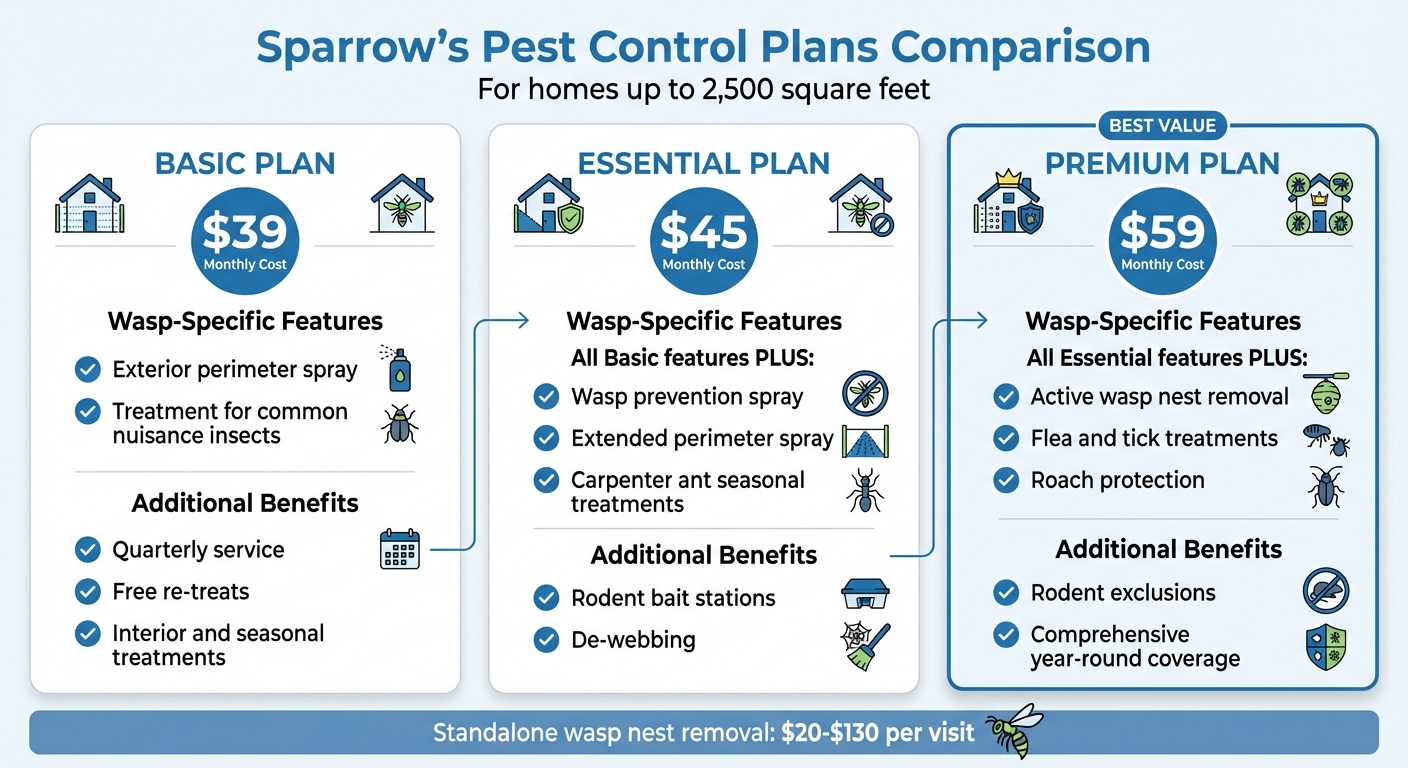
Sparrow’s Pest Control Plans Comparison
Sparrow’s offers three service plans designed for homes up to 2,500 square feet. Each plan builds on the features of the previous one:
| Plan | Monthly Cost | Wasp-Specific Features | Additional Benefits |
|---|---|---|---|
| Basic | $39 | Exterior perimeter spray; treatment for common nuisance insects | Quarterly service; free re-treats; interior and seasonal treatments |
| Essential | $45 | Includes all Basic features plus wasp prevention spray, extended perimeter spray, and carpenter ant seasonal treatments | Rodent bait stations; de-webbing |
| Premium | $59 | Includes all Essential features plus active wasp nest removal, flea and tick treatments, and roach protection | Rodent exclusions; comprehensive year-round coverage |
If you’re looking to prevent nests, the Essential plan is a solid choice. For active nest removal, go with the Premium plan. Considering that standalone wasp nest removal can cost anywhere from $20 to $130 per visit, Sparrow’s monthly plans offer a budget-friendly way to keep your home protected year-round.
Conclusion: Managing Wasps Around Your Home
The first step in managing wasps effectively is removing anything that might attract them. Adjusting your prevention strategies based on the season can make a noticeable difference.
It’s important to remember that not all wasp activity calls for removal. Wasps play a vital role as pollinators and natural predators of pests like aphids and caterpillars. Michael Skvarla, Assistant Research Professor at Penn State University, highlights their contribution:
"Paper wasps, for example, are specialist predators of caterpillars and each nest can consume hundreds of caterpillars per season"
If a nest is located in an area where it doesn’t pose a risk, it might be worth leaving it alone. Striking a balance between the ecological benefits these insects offer and the potential risks they bring is key. However, when wasp activity becomes a concern, timely action is essential.
For safe removal, timing is everything. Smaller nests that are easy to access can be dealt with at night or early in the morning when wasps are less active. But if the nest is large (bigger than a grapefruit), located in a wall void, or if allergies are a concern, it’s best to call in professionals.
When DIY solutions aren’t enough, professional pest control services are the safest route. Companies like Sparrow’s Pest Control use specialized tools and EPA-approved products, offering a 100% satisfaction guarantee. In many cases, professional help is not only safer but also more cost-effective than repeated attempts to handle the problem yourself.
The key takeaway? Stay proactive. Seal up entry points, manage waste carefully, keep your yard tidy, and conduct regular inspections. These straightforward steps can help you keep wasps away and maintain a safe, comfortable home.
FAQs
What are the best ways to keep wasps from nesting in my yard?
To keep wasps from setting up shop in your yard, the trick is to eliminate what attracts them and block their potential nesting spots. Wasps are drawn to food, moisture, and shelter, so making your outdoor space less appealing is the way to go.
Start by cleaning up any food or drink spills right away, tightly sealing trash cans, and removing fallen fruit from the ground. Seal off possible nesting areas by filling in ground holes, fixing cracks in siding, and getting rid of wood piles or hollow objects. You can also plant herbs like mint, basil, or peppermint near patios or decks – these naturally repel wasps. Don’t forget to reduce standing water by clearing out gutters and avoiding open water containers in your yard.
If wasps are still buzzing around despite your efforts, it might be time to call in the pros. Sparrow’s Pest Control offers safe and effective wasp removal and prevention services in Bellingham, WA, helping keep your yard comfortable and pest-free all year long.
What are some natural ways to keep wasps away?
If you’re looking to keep wasps at bay without resorting to chemicals, natural repellents can be a great option. Many strong scents are unpleasant to wasps, and certain plants can act as a natural deterrent. Consider adding aromatic herbs and flowers like peppermint, lemongrass, thyme, marigolds, and citronella to your outdoor spaces. These work well in garden borders, pots, or even hanging baskets placed near windows, doors, and patios to create a fragrant barrier.
You can also make a simple homemade spray to discourage wasps from nesting. Combine 10–20 drops of essential oils – peppermint, clove, or lemongrass are all good choices – with water and a small amount of dish soap. Use this mixture to spray areas where wasps might build nests, such as eaves or window frames, and reapply every few days during warmer months to maintain its effectiveness.
For larger problems, like an established nest, professional help might be the safest route. Sparrow’s Pest Control, serving Bellingham, WA, and nearby areas, offers wasp removal and prevention services. Their family- and pet-friendly methods provide a safe and lasting solution to keep your home wasp-free.
When should I hire a professional for wasp control?
If the wasp nest is in a busy area, has grown too large to handle, or the wasps are acting aggressively, it’s a good idea to call in a professional. Attempting to deal with it yourself in these situations could lead to injury or make the problem worse. If you’re uncertain about how to safely remove the nest, leaving it to experts is the best choice.
Professionals not only remove the nest safely but can also take steps to prevent wasps from coming back. This ensures your home stays protected and gives you peace of mind.