Washington homes face year-round ant activity due to the state’s mild, wet climate. Common culprits include carpenter ants, odorous house ants, and moisture ants, each posing unique challenges. Carpenter ants damage wood, odorous house ants contaminate food, and moisture ants signal decay. Ant activity peaks between April and June but persists indoors throughout the year.
Key Prevention Tips:
- Eliminate food sources: Store food in airtight containers, clean up crumbs, and secure pet food.
- Seal entry points: Use caulk, weather stripping, and foam to block cracks and gaps.
- Control moisture: Fix leaks, ensure proper drainage, and keep wood dry.
- Landscaping adjustments: Keep mulch and firewood away from your home’s foundation.
Signs of Infestation:
- Visible ant trails, nests in damp areas, and structural damage like sawdust piles.
If DIY methods fail or you notice structural damage, professional pest control services can ensure effective elimination and long-term prevention.
7 Genius Ways to Get Rid of ANTS!
If these DIY methods don’t stop the infestation, professional Bellingham pest control can provide a permanent solution.
sbb-itb-be66415
Ant Species in Washington Homes
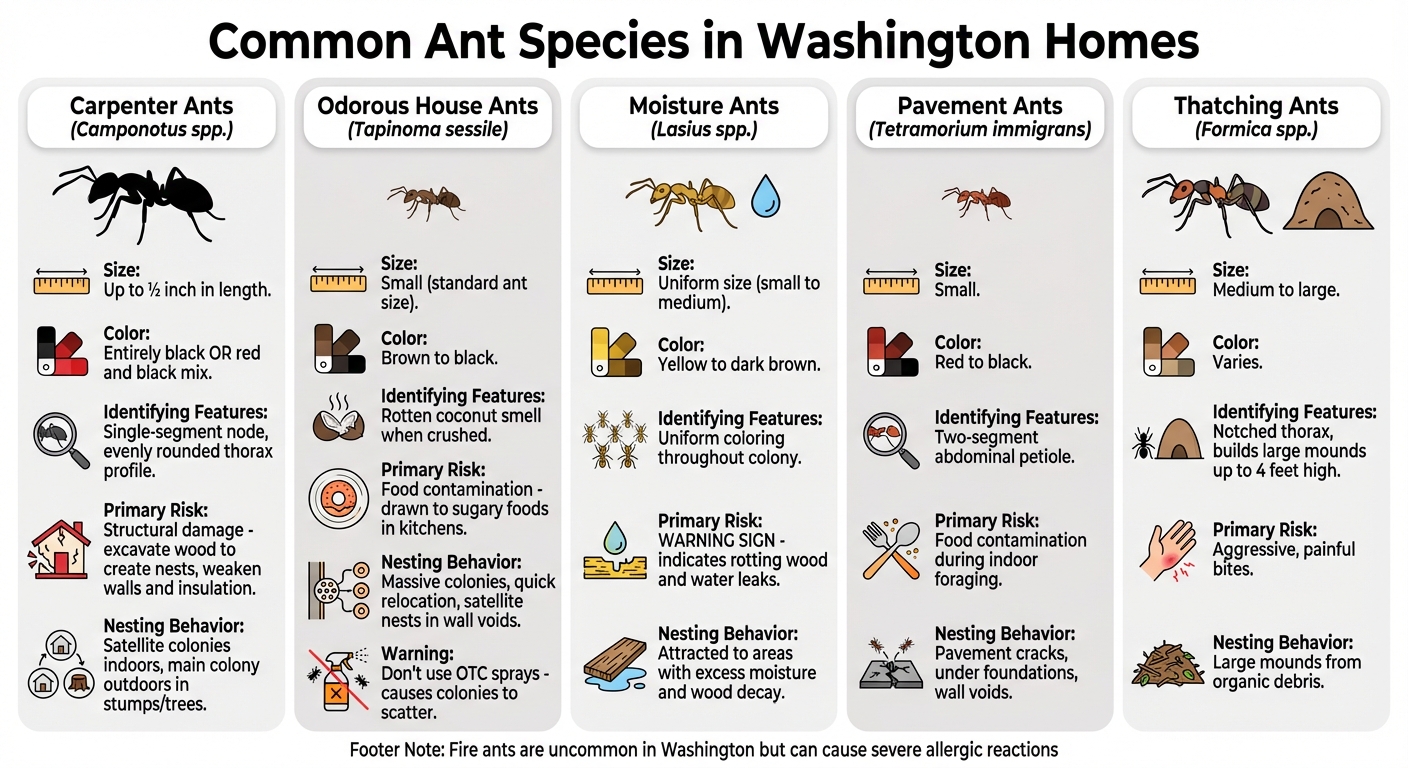
Common Ant Species in Washington Homes: Identification and Risks
Bellingham and Washington homes often encounter various ant species, each bringing its own challenges. Here’s a closer look at some of the most common species, their behaviors, and the risks they pose.
Carpenter Ants
Carpenter ants (Camponotus spp.) are among the most problematic structural pests in the Pacific Northwest. These large ants, measuring up to ½ inch in length, are either entirely black or a mix of red and black. Unlike termites, they don’t eat wood but instead excavate it to create nests. This tunneling can weaken sound, dry wood, as well as wall voids and insulation. Carpenter ants are identifiable by their single-segment node and the evenly rounded profile of their thorax. Infestations often involve satellite colonies inside homes, while the main colony typically remains outdoors in stumps or trees.
Odorous House Ants
Odorous house ants (Tapinoma sessile) are infamous for the rotten coconut smell they emit when crushed. These ants are particularly drawn to sugary foods, making them a frequent nuisance in kitchens. They form massive colonies that can relocate quickly, often establishing satellite nests within wall voids. This behavior increases the risk of food contamination. Using over-the-counter sprays on these ants is not recommended, as repellent chemicals can cause the colonies to scatter and form new groups.
Pavement Ants and Little Black Ants
Pavement ants (Tetramorium immigrans) are small ants that range in color from red to black. They typically nest in pavement cracks, under foundations, or within wall voids, and they may venture indoors while foraging for food. A key feature distinguishing them from carpenter ants is their two-segment abdominal petiole, which is a useful identification marker.
Moisture Ants
Moisture ants (Lasius spp.) vary in color from yellow to dark brown and are uniform in size. Their presence often signals underlying problems, as they are attracted to rotting wood and areas with excess moisture. These ants are a warning sign of wood decay or water leaks, both of which require immediate attention to prevent further structural damage.
Fire Ants and Thatching Ants
Fire ants are uncommon in Washington, but their stings can cause severe allergic reactions, which, in rare cases, may be fatal. On the other hand, thatching ants (Formica spp.) are known for building large mounds from organic debris, sometimes reaching heights of four feet. These ants are aggressive and deliver painful bites. They can be identified by their notched thorax.
Seasonal Ant Activity in Washington
Year-Round Activity
Many homeowners think ants vanish during Washington’s colder months, but that’s not entirely true. Indoor infestations can persist all year long. Once ants establish a colony inside your home, the stable indoor conditions – consistent warmth and easy access to food – enable them to stay active even when it’s freezing outside. In fact, colonies can survive for over 20 years once they’re firmly rooted. During winter, vacuuming up these invaders can help, though residents in our Washington service areas often find, while reserving professional chemical treatments for early spring is often more effective. These year-round indoor colonies set the stage for the seasonal surges that follow.
Peak Activity in Spring and Summer
Spring kicks off the busiest time for ant activity in the Pacific Northwest. From April to June, rising temperatures wake colonies from their winter dormancy, sparking rapid growth. Carpenter ants, known for causing structural damage, are especially active during this time. Early spring can be particularly challenging because outdoor food sources, like aphid honeydew, aren’t readily available yet, so worker ants aggressively forage indoors, especially in kitchens and bathrooms.
Heavy rains during this season also play a role. Saturated soil can collapse ant burrows, driving them indoors. The pressure from waterlogged ground pushes moisture into foundation cracks, attracting moisture-loving ants and forcing ground-dwelling species to move upward – often into homes.
Summer brings a different set of issues. Stuart Reitz, Director of Malheur Experiment Station at OSU Extension, notes that extreme heat, heavy rain, and leftover food residues can trigger more ant invasions. During the summer, ants search for moisture and shelter from the heat. Spring also sets the stage for reproductive swarming, when colonies release winged males and females to establish new colonies. This leads to the highest visible activity levels as these reproductives emerge in large numbers.
To stay ahead of infestations, placing ant baits in late winter or early spring is a smart move. This timing lets you tackle colonies early, before their numbers explode during the warmer months. Having a clear understanding of these seasonal patterns helps homeowners detect early signs of infestations and take timely action to prevent them from escalating.
Signs of an Ant Infestation
Visible Ant Trails
Spotting ant trails early can help you stop an infestation before it gets out of hand. Ants use pheromone trails to guide others to food or water sources. These trails are often found along baseboards, countertops, window frames, or near pipe entry points in your home. If you notice a single ant, try following its path – it might lead you to their entry point.
Where the trail ends can reveal what’s attracting the ants. Trails leading to outdoor plants might mean they’re feeding on aphid honeydew, while indoor trails often lead to food scraps or areas with moisture-damaged wood. To distinguish ants from termites, remember that ants have a narrow waist, and their forewings are larger than their hind wings. Tracing these trails can often lead you to their nest.
Nest Locations
Locating the nest is a key step in controlling an ant problem. In Washington homes, ants often nest in wall voids, under the house, or in areas with moisture-damaged wood. Landscaping materials like bark mulch or compost that touch your home’s siding can also act as a bridge for ants moving indoors.
Kitchens are a hotspot for infestations, thanks to food residues. Carpenter ants, in particular, are drawn to moisture-damaged wood and may set up satellite colonies inside walls.
Structural Damage and Food Contamination
Besides trails and nests, there are other signs that an infestation is causing trouble. Carpenter ants, for instance, don’t eat wood like termites, but they hollow it out to build nests. This can leave behind sawdust-like debris near door frames or baseboards, which could signal significant structural issues over time.
Food contamination is another red flag. If you find ants in food containers, on countertops, or even on indoor plants, it’s likely they’ve established a colony in or near your home. During Washington’s rainy season, moisture buildup in foundations and structural wood becomes especially appealing to ants seeking dry shelter. Regular checks for moisture can help prevent colonies from forming.
Ant Prevention Strategies for WA Homes
Eliminating Food Sources
When heavy rain hits, ants often seek shelter indoors, and food is a major draw. To keep them at bay, ensure your kitchen stays clean and all food items – including human food, pet food, bird seed, and grass seed – are stored in airtight containers.
After a storm, take the time to deep clean under your range and refrigerator to remove hidden crumbs and spills that might attract ants. Outdoor attractants also matter: bird feeders can drip sugary residue onto decks, and pet bowls left on porches can become ant magnets. Even non-food items like grass seed stored in garages can lure ants if the packaging absorbs moisture and releases odors. If you have chickens or livestock, store their feed in metal cans with tight lids and elevate feeders to keep them off the ground. Additionally, wipe down door thresholds and porch areas where food may have spilled to eliminate any lingering scent trails.
Once food sources are under control, the next step is securing your home by addressing entry points.
Sealing Entry Points
To stop ants from entering, trace active trails to find where they disappear – this is often behind baseboards, near electrical outlets, or around water pipes. Outside, common entry points include cracks in the foundation, gaps around windows and doors, and areas where utility pipes or wiring enter the house.
| Common Entry Point | Recommended Sealing Method |
|---|---|
| Window and Door Frames | Caulk, weather stripping, or sealant |
| Pipe and Wiring Chases | Expanding foam or silicone caulk |
| Foundation Cracks | Concrete filler or masonry sealant |
| Electrical Outlets | Foam gaskets or internal wall treatments |
To further minimize access, trim tree branches and shrubs that touch your siding or roof, as ants often use vegetation as a bridge. Keep landscaping materials, such as mulch or compost, at least 10–12 inches away from your foundation to discourage nesting. Check under patio blocks, stepping stones, or firewood piles near your home – these can harbor colonies ready to invade.
Moisture Control and Wood Maintenance
Managing moisture is just as important as removing food sources. Proper drainage around your home’s exterior can go a long way in deterring ants. After heavy rain, inspect your perimeter for standing water. Make sure downspouts discharge water at least 6 to 10 feet away from your foundation and install gutter guards to keep water flowing properly. Regrade the soil around your home so it slopes away from the foundation for the first 6 feet, reducing hydrostatic pressure that might encourage ants to move in. Additionally, trim vegetation touching your home and clean gutters and fascia regularly to prevent water buildup and rot, which can attract moisture-loving ants.
Outdoor Landscaping Tips
Once you’ve addressed indoor risks, it’s time to focus on your outdoor spaces. Create a dry perimeter around your home to discourage ant trails. Replace organic mulch with rock or pea gravel in an 8–12 inch buffer zone to reduce moisture retention. If you use mulch elsewhere, keep it 3 to 6 inches below your siding and maintain an 8 to 12 inch gap from your foundation. Store firewood at least 20 feet away from your home and elevate it 1 foot off the ground to prevent ants from nesting. Similarly, keep items like lumber or yard tools at least 6 inches away from exterior walls to improve airflow and make monitoring easier.
For utility penetrations, use steel mesh and mortar instead of foam, which pests can easily bypass. Lastly, consider switching to warmer color temperature LEDs or motion-sensor lighting for outdoor areas. These options attract fewer insects, which can serve as food for ants.
When to Call a Professional Pest Control Service
Persistent Infestations or Severe Damage
If ants keep coming back despite your best efforts, it’s likely time to bring in the professionals. Over-the-counter sprays might take care of the ants you see, but they often fail to eliminate the queen. Instead, these sprays can scatter the colony into multiple satellite nests. This is especially concerning since ant colonies can grow to over 100,000 members.
According to the Pacific Northwest Pest Management Handbooks, "Over-the-counter pesticide sprays are highly repellent to ants and may scatter ants throughout a structure."
Carpenter ants, in particular, demand immediate attention. If you notice large black ants with wings or piles of sawdust-like material (called frass) near wooden structures, it’s a clear sign to call a professional.
When DIY solutions don’t work, professional help becomes the best course of action.
Benefits of Professional Services
Professional pest control services, like Sparrow’s Pest Control, use advanced techniques and products to tackle infestations effectively. They rely on non-repellent treatments that foraging ants carry back to the queen, ensuring the entire colony is wiped out. These experts also trace chemical pheromone trails, which helps them locate entry points and nesting sites that might go unnoticed by homeowners.
Beyond just eliminating ants, technicians perform detailed inspections to identify structural issues – like moisture in wood or foundation gaps – that can make your home more vulnerable to infestations, especially during rainy seasons. Sparrow’s Pest Control prioritizes safety by using methods that are safe for families and pets. They also back their work with a 100% satisfaction guarantee. Their customizable plans include follow-up visits to ensure no satellite colonies reappear.
For example, their Basic plan starts at $39/month for homes up to 2,500 square feet. This package includes quarterly service, an exterior perimeter spray, and free re-treatments if ants return.
Conclusion
To keep ants at bay, focus on three key strategies: block their entry points, remove food and moisture sources, and call in professionals when needed. Prevention works best when tailored to the common household pests you’re dealing with. Simple steps like keeping mulch 3–6 inches below siding, storing food in airtight containers, and checking foundation lines after heavy rain can go a long way in avoiding infestations.
Washington’s rainy climate can turn small maintenance issues into bigger problems during the wet season. As Sparrow’s Pest Control puts it, "Our wet climate magnifies small maintenance gaps, turning what looked fine in August into an invitation by October". If you’re seeing multiple ant colonies indoors after rain or if baiting hasn’t worked after three weeks, it’s probably time to call in the experts.
When it comes to treatment, pesticide baits are far more effective than over-the-counter sprays. Worker ants carry the slow-acting toxins back to the queen, ensuring the entire colony is eliminated. However, baits take time – often several weeks – to work, while sprays can scatter the ants, pushing them deeper into walls. Understanding this helps you decide when professional help is the right move.
For ongoing infestations or carpenter ant damage, Sparrow’s Pest Control offers tailored plans starting at $39/month for homes up to 2,500 square feet. Their services include non-repellent barriers, moisture inspections, and follow-ups to ensure your home stays protected. Visit them at 3969 Hammer Dr, Bellingham, WA 98226, or call (360) 517-7378 to schedule a free inspection.
FAQs
Which ant species are in my WA home?
Common ant species often encountered in Washington homes include carpenter ants, velvety tree ants, Pharaoh ants, thief ants, pavement ants, odorous house ants, and harvester ants. Recognizing which species you’re dealing with is crucial for managing and preventing infestations effectively.
Why do ants keep coming back after rain?
Ants tend to show up after rain because the heavy downpour floods their nests, pushing them out of the soaked soil. When this happens, they often look for dry places to take refuge, which can include your home. They’ll slip in through tiny cracks in your foundation or gaps in siding, drawn by the promise of shelter, food, and water.
To keep them out, make sure to seal any potential entry points around your home. Also, tackle any moisture problems, like leaks or standing water, that might be attracting them.
When should I call Sparrow’s Pest Control?
If heavy rain brings pests into your home or you’re looking for expert pest prevention and extermination services in Bellingham, WA, reach out to Sparrow’s Pest Control. They specialize in dealing with ants, spiders, rodents, and other pests, offering tailored solutions to ensure your home stays pest-free.